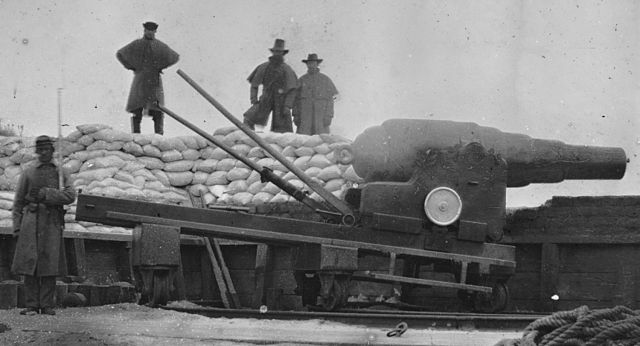
Oh! long enslaved millions, whose cries have so vexed the air and sky, suffer on a few more days in sorrow, the hour of your deliverance draws nigh!
-- Frederick Douglass, regarding the Emancipation Proclamation.

Eyeball another Civil War quote »


Southern States Secede

Secession fever hit the South after Abraham Lincoln was elected president. The South considered Lincoln's Republican party victory in the 1860 presidential election as a sign that the North was now going to end the "peculiar institution" of slavery. For the South, the time of talk and compromise had ended. In December, 1860 South Carolina became the first state to secede from the Union. Secession of the rest of the states that would make up the Confederate States of America occurred in two waves.
Read More...
Virginia Ordinance of Secession...
The Confederate States of America...


Seeing the Elephant

By Jonathan R. Allen - Last updated: Monday, July 20, 2009- 3 Comments

Seeing the Elephant – How it Feels to be Under Fire

During the Civil War, soldiers would speak about "Seeing the elephant." The "elephant" was battle, combat, being under enemy fire.
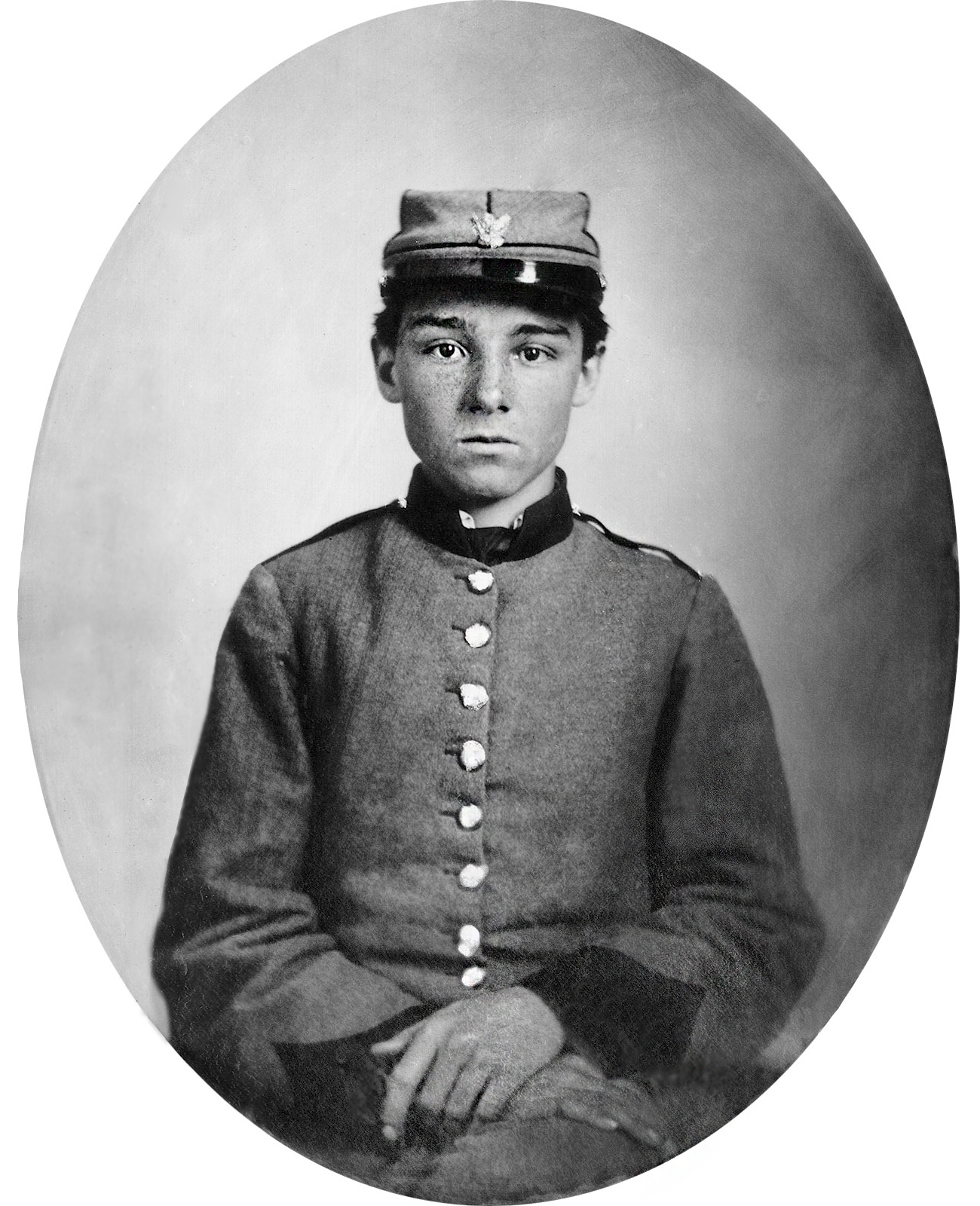


Both the Confederacy and the Union had armies made up mostly of volunteers, with much fewer soldiers actually belonging to the Regular Army. Whether volunteer or Regular Army, the vast majority of these young men had never faced enemy fire. Many were away from home for the first time in their young lives. They had lived quietly and peacefully in small towns, farms, or cities. Now, they were learning to kill, and facing the great possibility of being killed.

As these men trained and marched, preparing for battle, the thought of "Seeing the elephant" for the first time weighed on their minds.

  Barnes&Noble: National Geographic Atlas of the Civil War

Atlas of the Civil War: A Complete Guide to the Tactics and Terrain of Battle


”It’s just like shooting squirrels, only these squirrels have guns.”
– A Federal veteran instructing new recruits in a musket drill.


  Barnes&Noble: Co Aytch Maury Grays First Tennessee Regiment Or A Side Show Of The Big Show by Sam R. Watkins

Co. Aytch, Maury Grays, First Tennessee Regiment; Or, A Side Show Of The Big Show
 

“Bang, bang, bang, a rattle, de bang, bang, bang, a boom, de bang…whirr-siz-siz-siz–a ripping, roaring, boom, bang!”
Confederate Sam R. Watkins describing a "fire fight." Sam Watkins was twenty-one years old and from Columbia, Tennessee when he joined up to fight in the Civil War. He kept a journal and recorded his experiences and thoughts during the war. His words give us great insight into the Civil War.


“It was eyes right, guide center! Close-up, guide right, halt, forward, right oblique, left oblique, halt, forward, guide center, eyes right, dress up promptly in the rear, steady, double quick, charge bayonets, fire at will, is about all that a private soldier knows of a battle.”
– Confederate Sam R. Watkins.


I was a ploughboy in the field,
A gawky, lazy, dodger,
When came the conscript officer
And took me for a sodger.
He put a musket in my hand,
And showed me how to fire it;
I marched and counter-marched all day;
Lord, how I did admire it!

– This tune is "The Valiant Conscript" and it is sung to the music of "Yankee Doodle."


“Our men are not sufficiently impressed with a sense of honor that it is better to die by fire than to run.”
– General William Hardee of the Confederacy.


“War is at best barbarism…Its glory is all moonshine. It is only those who have neither fired a shot, nor heard the shrieks and groans of the wounded who cry aloud for blood, more vengeance, more desolation. War is hell.”
William Tecumseh Sherman. These words are from his June 19, 1879 address to the Michigan Military Academy.


“We made a bargain with them that we would not fire on them if they would not fire on us, and they were as good as their word. It seems too bad that we have to fight men that we like.”
– Words of a Union soldier.


Perhaps some of you reading the LearnCivilWarHistory.com blog are veterans or soldiers who know full well what it is like to under fire. However, for most us, we can only wonder and imagine what it is like to be "Seeing the elephant," just as the young men of the Civil War wondered and imagined so many years ago.

Below are the experiences of being under Civil War fire as described by Captain Frank Holsinger. Try to imagine yourself in Captain Frank Holsinger’s shoes (or rather, brogans) as you read this stirring account of what it was like to be "Seeing the elephant” in the Civil War:


Excerpts from: How Does One Feel Under Fire?
by Captain Frank Holsinger, 19th United States Colored Infantry.


"My sensations at Antietam were a contradiction. When we were in line "closed en masse" passing to the front through the wood at "half distance," the boom of cannon and the hurtling of shell as it crashed through the trees or exploding found its lodgment in human flesh; the minies sizzling and savagely spotting the trees; the deathlike silence save the "steady men" of our officers. The shock to the nerves were indefinable–one stands, as it were, on the brink of eternity as he goes into action. One man alone steps from the ranks and cowers behind a large tree, his nerves gone; he could go no longer. General Meade sees him, and, calling a sergeant, says, "Get that man in ranks." The sergeant responds, the man refuses; General Meade rushes up with, "I’ll move him!" Whipping out his saber, he deals the man a blow, he falls–who he was, I do not know. The general has no time to tarry or make inquiries. A lesson to those witnessing the scene. The whole transaction was like that of a panorama. I felt at the time the action was cruel and needless on the part of the general. I changed my mind when I became an officer, when with the sword and pistol drawn to enforce discipline by keeping my men in place when going into conflict.


  Barnes&Noble: Ambrose Bierce: Civil War Stories

Ambrose Bierce: Civil War Stories
 

"When the nerves are thus unstrung, I have known relief by a silly remark. Thus at Antietam, when in line of battle in front of the wood and exposed to a galling fire from the cornfield, standing waiting expectant with “What next?” the minies zipping by occasionally, one making the awful thud as it struck some unfortunate. As we thus stood listlessly, breathing a silent prayer, our hearts having ceased to pulsate or our minds on home and loved ones, expecting soon to be mangled or perhaps killed, some one makes an idiotic remark; thus at this time it is Mangle, in a high nasal twang, with “D—–d sharp skirmishing in front.” There is a laugh, it is infectious, and we are once more called back to life.
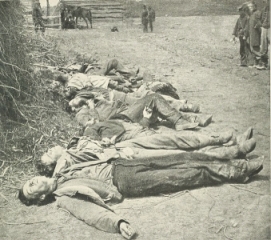


"The battle when it goes your way is a different proposition. Thus having reached the east wood, each man sought a tree from behind which he not only sought protection, but dealt death to our antagonists. They halt, also seeking protection behind trees. They soon begin to retire, falling back into the corn-field. We now rush forward. We cheer; we are in ecstasies. While shell and canister are still resonant and minies sizing spitefully, yet I think this one of the supreme moments of my existence … The worst condition to endure is when you fall wounded upon the field. Now you are helpless. No longer are you filled with the enthusiasm of battle. You are helpless—the bullets still fly over and about you—you no longer are able to shift your position or seek shelter. Every bullet as it strikes near you is a new terror. Perchance you are enabled to take out your handkerchief, which you raise in supplication to the enemy to not fire in your direction and to your friends of your helplessness. This is a trying moment. How slowly time flies! Oh, the agony to the poor wounded man, who alone can ever know its horrors! Thus at Bermuda Hundreds, November 28th, being in charge of the picket-line we were attacked, which we repulsed and rejoiced, yet the firing is maintained. I am struck in the left forearm, though not disabled; soon I am struck in the right shoulder by an explosive bullet, which is imbedded in my shoulder strap. We still maintain a spiteful fire. About 12 M. I am struck again in my right forearm, which is broken and the main artery cut; soon we improvise a tourniquet by using a canteen-strap and with a bayonet the same is twisted until blood ceases to flow. To retire is impossible, and for nine weary hours or until late in the night, I remain on the line. I am alone with my thoughts; I think of home, of the seriousness of my condition; I see myself a cripple for life—perchance I may not recover; and all the time shells are shrieking and minie bullets whistling over and about me. The tongue becomes parched, there is no water to quench it; you cry “Water! Water!” and pray for night; that you can be carried off the field and to the hospital , and there the surgeons’ care—maimed, crippled for life, perchance to die. These are your reflections. Who can portray the horrors coming to the wounded?"


At the completion of Captain Frank Holsinger’s military service, he was given a brevet rank of major. Holsinger settled in Kansas.

Print Friendly
Share

Suggested Posts to Learn More...

3 Responses to “Seeing the Elephant”

Pingback from Seeing the Elephant | Fashion e Music Blog
Time July 20, 2009 at 5:09 PM

[...] View original post here: Seeing the Elephant [...]

Pingback from “ethnically motivated secession” | SOUTHRON THUNDER
Time December 1, 2009 at 11:01 PM

[...] ["Seeing the elephant" WAS PERHAPS THE EASIEST PART OF THE STRUGGLE OUR FOLK FACED ...] Civilian life during ABOLITION War the topic at historical symposium ShenandoahValley.com -‎ Mothers became separated from children as families huddled in basements as Onion and Confederate soldiers clashed. Tiny communities overwhelmed with dead … [...]

Comment from John McGeehan
Time February 7, 2011 at 10:38 PM

The battles were only part of the killing-the biggest killer was disease. Unsanitary conditions
alone caused infection and blood poisoning, diptheria,malaria,typhoid,pneumonia, The lack of qualified medical people created cripples and drug addiction and untold misery. More men died from disease related causes than from bullet wounds.
Napoleonic field attack marches shoulder to shoulder
was an ancient military tact,and put men out as easy targets to be slaughtered. Many lives were
lost through ignorance and poor judgment.

Write a comment


Add Comment


Follow CivilWarHistory on Twitter


Subscribe

RSS Feed
RSS
Subscribe

Future Posts

First Lines Color Key

Gold = antebellum
Green = 1861
Navy = 1862
Purple = 1863
Orange = 1864
Red = 1865
Brown = postbellum
Cyan = Other

Barnes&Noble Has Civil War Books, CDs, DVDs

BarnesandNoble.com Logo - 120x60

Civil War Top 100

Civil War Top 100

facebook

Learn Civil War History

Promote Your Page Too

Twitter

Follow Me on Twitter!
Follow CivilWarHistory

EzineArticles Platinum Expert Author

Jonathan R. Allen, EzineArticles.com Platinum 
Author
Links I Like ...

First Lines Color Key

Gold = antebellum
Green = 1861
Navy = 1862
Purple = 1863
Orange = 1864
Red = 1865
Brown = postbellum
Cyan = Other

Monthly Archives

Civil War Posters and Prints

Confederate General Robert E. Lee in 1862 or 1863
Confederate...

12 in. x 16 in.
Buy This at Allposters.com


General Ulysses S. Grant
General Ulysses...

Buy This at Allposters.com


General William T. Sherman
General William...

12 in. x 16 in.
Buy This at Allposters.com


Battle of Gettysburg
Battle of...
C.d. Graves
12 in. x 9 in.
Buy This at Allposters.com
Welcome

RSS Feed The purpose of this Civil War blog is to help you Learn Civil War History. You are invited to read about a crucial time in the history of the United States: the Civil War. Any and all aspects of the Civil War will be subjects on this blog. Battles, leaders, soldiers, civilians, abolitionists, slaves, freed slaves, politics, politicians, civilians and their lives during the war, equipment, animals, cavalry, infantry, artillery, medicine, Rebels and Yankees, heroes, villains, and scoundrels... and all other topics of the Civil War will be discussed. Your comments and thoughts are always welcome. The Civil War is a rich, broad, fascinating, and interesting subject to learn about. So, join me and Learn Civil War History!
-- Jonathan R. Allen
BlogMaster.
A sister website of
www.nellaware.com.

"The histories of the Lost Cause are all written out by big bugs, generals and reknowned historians. Well, I had as much right as any man to write a history."
-- Sam Watkins, of Company H, 1st Tennessee of Nashville.

And He shall judge among the nations, and shall rebuke many people; and they shall beat their swords into plowshares, and their spears into pruning-hooks. Nation shall not lift up sword against nation, neither shall they learn war any more.
(Isaiah 2:4)

Popular Posts

Categories

Recent Entries

BlogMaster Picks


The History Channel, A&E, and Biography


The American Civil War DVD Set


The Hunley Secrets Revealed DVD


Lincoln: His Life and Legacy DVD Set