Robert Smalls was a slave born on April 5, 1839 in Beaufort, South Carolina. His mother was a house slave, his father an unknown white man. When Robert was only 12-years-old, he began working in the Charleston, South Carolina shipyards.
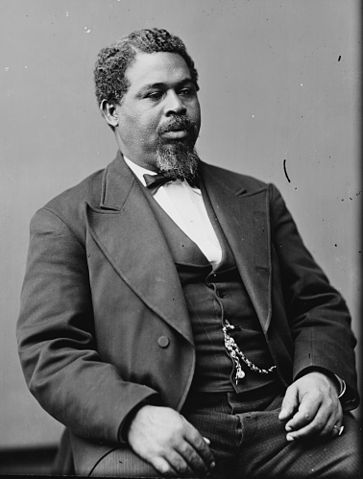
Robert Smalls
On May 13, 1862 slave Robert Smalls dressed as the Planter’s captain, and with help from family and other slaves, he commandeered the boat. As a ship pilot, Smalls knew the necessary signals that would allow the Planter to get by the Rebel-held Fort Sumter. Smalls took the Planter out to the Yankee navy boats blockading Charleston, and turned the boat over to the Union. Smalls, and the other slaves on board, gained their freedom. The Union got the Planter, along with four cannon, the cannon’s armament, and important intelligence regarding Confederate defenses in Charleston.
Smalls continued to pilot boats, but now he did it for the Union. As a civilian, Robert Smalls became the Planter’s captain and the boat took part in 17 engagements during the Civil War. On April 7, 1863 Smalls was piloting an ironclad ship named Keokuk during an attack on the Rebel-held Fort Sumter. During a flotilla attack of this engagement, Smalls was injured in his eyes while piloting the Keokuk. The ironclad Keokuk Smalls piloted was hit 90 times, most of the hits were at or below the ironclad’s waterline. The Keokuk sank the next day.
Robert Smalls was rewarded with fame and fortune for his heroic actions. Smalls met President Abraham Lincoln, and helped in fund-raising activities. Smalls learned how to read. President Lincoln signed a Congressional bill awarding prize money in the amount of $1500 to Smalls (Smalls’ associates also received money).
In August of 1862, Robert Smalls and a missionary named Mansfield French met with President Lincoln and Secretary of War Edwin Stanton. Smalls and Mansfield were asking Lincoln and Stanton for authorization to recruit African-American troops. Soon permission to raise the African-American troops was obtained.
Robert Smalls’ success did not end when the Civil War ended. After the Civil War, Smalls purchased the home of his former owner and master, and the slave quarters he was born in. He lived in his former master’s home the rest of his life. Smalls became a politician and served in the South Carolina house of representatives for two years, and then in the state senate for three years. His record was not without blemish however, as a state senator Smalls took a $5,000 bribe and was sentenced to three years in prison. Smalls was pardoned and served no time.
Robert Smalls was elected to the United States House of Representatives in 1875 and served five terms. Later, he was the collector for the Beaufort, South Carolina port. Congress awarded Robert Smalls a $30 a month pension in 1897, then he was awarded $5,000 in 1900 for capturing the side-wheeler Planter. Smalls died in 1915.
There is nothing small about Robert Smalls’ life accomplishments.
Learn Civil War History Podcast Episode Seven: Freedman Jourdon Anderson Writes A Letter To His Old Master
Spotify
Robert Smalls
