Facts About Washington D.C. During The Civil War

Washington D.C. In The Civil War

Washington D.C. – the Capital of the United States

Washington D.C. went through many changes during the Civil War.

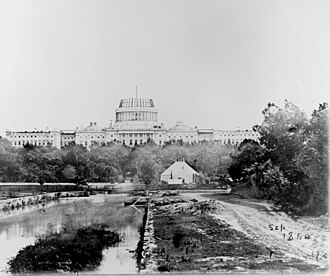
    Capitol Under Construction in Washington D.C. 1860.

  • Washington D.C. underwent a dramatic transformation during the Civil War, evolving from a relatively small, underdeveloped city into a bustling, heavily fortified Union capital.
  • Washington D.C. served as the official capital of the Union throughout the entire Civil War.
  • Washington D.C. was strategically and precariously located, sandwiched between Confederate Virginia and the border slave state of Maryland. It was highly vulnerable to attack by Rebel forces.
  • The population of Washington D.C. exploded during the Civil War. It increased from approximately 75,080 at the start of the war to an estimated 200,000 at its peak. There was an influx of soldiers, government workers, refugees, and formerly enslaved people who came to Washington D.C.
  • At the Civil War’s outset, Washington D.C. was largely undefended and vulnerable. There was only one old fort (Fort Washington) that was located 12 miles south of the city.
  • Following the First Battle of Bull Run/First Manassas, a massive fortification effort began in Washington D.C. resulting in a ring of defenses around the city.
  • By 1865, Washington D.C. was one of the most heavily fortified cities in the world. It had 68 enclosed forts, 93 detached batteries, 20 miles of rifle pits, and 32 miles of military roads.
  • The formidable Civil War defenses of Washington D.C. largely deterred direct Confederate assaults on the capital, though feints and indirect threats were common.
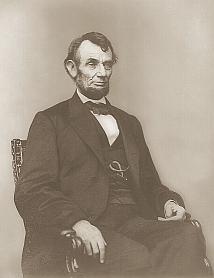
  • President Abraham Lincoln

    President Abraham Lincoln

  • President Abraham Lincoln famously observed the fighting at Fort Stevens on July 12, 1864,when Confederate Lt. Gen. Jubal Early’s forces assaulted the fort. This made him the only United States president to come under direct enemy fire while in office. At Fort Stevens, Lincoln was fired at by sharpshooters which prompted a Union officer to shout, “Get down, you damn fool!“.
  • The rapid population growth of Washington D.C. during the Civil War strained the city’s infrastructure and resources. The city was troubled with poor sanitation, muddy streets, and outbreaks of diseases like smallpox.
  • In Washington D.C. during the Civil War, many buildings, including the Patent Office and public halls, were converted into hospitals to care for the thousands of wounded Union soldiers arriving from the front lines.
  • Slavery was abolished in Washington D.C. in April 1862, it the first emancipated city and a magnet for formerly enslaved people.
  • “Freedom villages” and “contraband camps” sprang up around Washington D.C. to accommodate the thousands of formerly enslaved people seeking refuge and freedom.
  • During the Civil War in Washington D.C. many formerly enslaved people found employment and contributed to the war effort. They helped to construct the city’s defenses.
  • Beyond the military front, Washington D.C. was a major political battleground. There were intense debates over emancipation and the future of the nation.
  • In Washington D.C., the Civil War spurred advancements in medicine and technology. Thaddeus Lowe used balloons for reconnaissance with support from the Smithsonian Institution.
  • During the Civil War in Washington D.C. President Abraham Lincoln was a constant presence. He often visited hospitals, and oversaw military operations as he grappled with the severe challenges of the Civil War.
  • The infamous assassination of President Lincoln by cowardly actor John Wilkes Booth occurred at Ford’s Theatre in Washington, D.C. in April 1865.
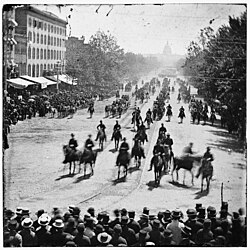
  • Grand Review in Washington D.C.

  • The Civil War officially ended with the Grand Review of the Armies in May 1865 when a massive parade of Union troops proceded through the streets of Washington, D.C.
  • The Civil War fundamentally transformed Washington D.C., laying the groundwork for its development into a major metropolitan center. There was enormous post-Civil War growth.
  • During and after the Civil War, Washington, D.C.’s character shifted from its Southern origins to a more Northern influence, reflecting the influx of Union supporters and freed-people.
Elizabeth Van Lew – A Union Spymaster in Richmond

Southerner Elizabeth Van Lew Supported the Union

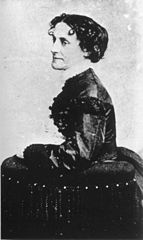
Elizabeth Van Lew

Elizabeth Van Lew

Richmond, Virginia, the capital of the Confederacy, had a crafty Union spy operating within it to subvert its secessionist rebel efforts. The spy was a woman named Elizabeth Van Lew.

Van Lew’s parents were from the North and her father John came to Richmond with his wife Eliza to become a hardware merchant. Their daughter Elizabeth was born in Richmond in 1818. John Van Lew’s hardware business prospered and the family lived in the upscale Church Hill neighborhood of Richmond. The family attended the historic Saint John’s Episcopal Church and the Van Lews became part of Southern society. They owned many slaves, despite mother Eliza and daughter Elizabeth believing slavery was evil and wanting it to end.

When the Southern states began seceding from the Union after Abraham Lincoln’s election as president in November 1860, young Elizabeth thought secession was a bad policy. Van Lew supported the Union, the Republican Party, and the abolition of slavery. She thought the opposite of what most all Southerners thought. When the Civil War began, Elizabeth had the means and opportunity to move North and be with other family members. Instead, Elizabeth chose to stay in Richmond, the seat of the Confederacy. She had plans.

She Gave Aid and Help to Libby Union Prisoners of War

Richmond’s Libby Prison held Union officer prisoners of war under difficult and overcrowded conditions. The prisoners suffered from disease and malnutrition, and the prison had a high death rate. Elizabeth Van Lew visited the prison pretending to be a loyal Southern lady living up to her Christian faith and womanly concern for others. She provided help and aid to the suffering and needy Yankee prisoners. Elizabeth used her family’s wealth to bribe guards and officials to gain favors and assistance for the prisoners. What she sneakily did, with her philanthropist and caring cover of helping the prisoners by giving them food and medicine, was to also help them escape.

Van Lew gathered information from the prisoners and passed it over to Union forces. In March 1862, President Jefferson Davis clamped down on Richmond with an iron fist of martial law. Many people thought to be Union supporters in the Confederate capital were arrested. Elizabeth Van Lew could no longer visit Libby Prison and give aid to the prisoners. This did not stop her clandestine pro-Union efforts in Richmond. She changed her tactics.

Learn Civil War History Podcast: Elizabeth Van Lew – A Union Spymaster in Richmond

Listen and learn about Elizabeth Van Lew.


The Richmond Underground

With Van Lew’s leadership, the Richmond Underground was organized as a Union spy ring. The Richmond Underground was a secret spy network made-up of whites and African-Americans. It helped Union prisoners escape from imprisonment and helped pro-Union Southerners flee to the North. Van Lew and other workers of the Richmond Underground arranged for escapees to have shelter in safe houses and provided them with disguises. The Van Lew family home was used as a safe house. Some members of the Richmond Underground helped escapees by accompanying and guiding them to safety within Union lines.

Her Spy In the Confederate White House

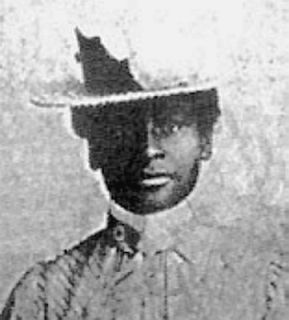
Mary Elizabeth Bowser

Mary Elizabeth Bowser

When Elizabeth Van Lew passed away in 1900, it was rumored that she’d had an African-American servant planted and working as a spy in the Confederate White House during the Civil War. This proved to be true. Mary Jane Richards Denham was an African-American lady whom the wealthy Van Lews had sent North for her education, and then on to Liberia. The Van Lews had Mary Jane return to Richmond shortly before the Civil War began. On her return to the South, with help from the Van Lews, Denham devised an identity as Mary Elizabeth Bowser to avoid detection and capture by Confederate authorities.

Mary Jane Richards Denham/Mary Elizabeth Bowser became an active spy in the Confederate White House. Those in the Confederate White House assumed she was a slave and illiterate. Conversations were not hidden from her. Mary would listen attentively and read what papers she could to gather information. After the Civil War, using the name “Richmonia Richards,” she gave a speech that was written up in a newspaper article. In her speech, she told of going, “into President Davis’s house while he was absent, seeking for washing” and then finding her way to an office where she, “opened the drawers of a cabinet and scrutinized the papers.”

Federal Service and Military Recognition

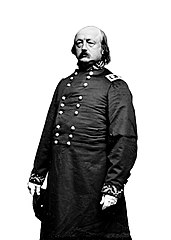
Ben Butler

Ben Butler

Major General Benjamin F. Butler recruited Elizabeth Van Lew and other Southern Unionists into Federal service. Van Lew’s spy efforts reached their peak. The Van Lew family home in Richmond became the heart and center of the Richmond Underground spy network. Van Lew was known as a spymaster. Her group of spies used code words and invisible ink in messages hidden in their clothing and shoes. These messages contained valuable intelligence for Union officers. As General Grant fought against the trench lines stretching from Petersburg to Richmond, the Richmond Underground provided him with information. This information included important news about the Confederate movement of men and matériel going back and forth in the east and the Shenandoah Valley.

After the Civil War, George H. Sharpe, the chief of military intelligence for the Army of the Potomac, wrote about contributions that spymaster Elizabeth Van Lew made to the Union. Sharpe wrote, “for a long, long time, she represented all that was left of the power of the U. S. Government in the city of Richmond.”