John Lincoln Clem
1851 – 1937
In June 1861, a small lad in Newark, Ohio gazed at Union troops marching through his town and despite his too young age, he wanted to join up and fight in the Civil War. The boy’s name was John Joseph Klem.
Earlier, Klem tried to enlist in the 3rd Ohio Infantry, but because of his age and small size, young Klem was turned away. Johnny Clem (he would be known by this name and spelling, later he would be called Johnny Shiloh, and officially he changed his name to John Lincoln Clem) was persistent with his desire to join the army, so he trailed along with the 22nd Massachusetts as it marched through Newark.
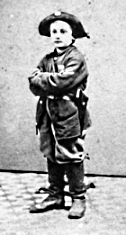
Johnny Clem
Two years later, Johnny Clem would be allowed to enlist. On May 1, 1863 Johnny officially became a musician in Company C, 22nd Michigan. A nurse describes Johnny Clem; “was a fair and beautiful child…about twelve years old, but very small for his age. He was only about thirty inches high and weighed about sixty pounds.” Johnny Clem was one of the youngest soldiers for either the Union or Confederate armies, to fight in the Civil War. Johnny would go on to fame in the Civil War, and make the army his career.
It has been common for Johnny Clem to also be known as “Johnny Shiloh.” A story goes that young Clem was at the 1862 Shiloh battle and his drum was broken by an artillery projectile, and then he picked up a gun for the fight. This story was very popular and eventually a poem, a play, and a song were all named “The Drummer Boy of Shiloh.” Clem at Shiloh however, is questionable history.
There were others who claimed to be the actual “The Drummer Boy of Shiloh,” but a study by the National Park Service showed Clem to be the most likely one. Clem’s service indicates he was with the 3rd Ohio, the 22nd Michigan, and the 22nd Wisconsin. The trouble is, is that the 3rd Ohio was not at Shiloh, and the 22nd Michigan, and the 22nd Wisconsin were not organized until after Shiloh. At this time, Johnny Clem was not yet officially a soldier, he was a young boy dressed up as a soldier trying to play the drum. He would not have been reassigned to any units that were at Shiloh. This BlogMaster will leave it up to the reader to decide if Johnny Clem is also Johnny Shiloh. We will see that there is no reason to doubt Johnny Clem’s bravery.
At Chickamauga on September 20, 1863 Johnny Clem rode to the front of the battle on an artillery caisson, carrying along his cut-down rifle. As the course of the battle played out, the Union troops had to retreat and during this a Confederate colonel encountered young Clem and demanded his surrender. Johnny Clem halted as if to comply, but then raised his cut-down rifle at the enemy officer and fired, wounding him.
On learning of Johnny’s exploits, General George H. Thomas promoted Johnny to the rank of lance corporal. Newspapers told Johnny Clem’s story and he gained celebrity status, becoming known as “The Drummer Boy of Chickamauga.”
In October, 1863 Johnny Clem was detailed as a train guard in Georgia when Confederate cavalry captured him. Johnny was freed two months later during a prisoner exchange, but the Confederate newspapers used his capture to ridicule the Union with this barb; “what sore straits the Yankees are driven, when they have to send their babies to fight us.”
Johnny Clem was assigned to General Thomas’s staff as a mounted orderly in January, 1864. During the Atlanta Campaign, young Johnny was twice wounded. On September 19, 1864 he was discharged from the army. President Grant gave Johnny Clem an appointment to West Point, but Johnny had spent his youth and times as a soldier. His lack of formal education prevented him from passing the West Point entrance exam.
President Grant came through for Johnny Clem again by making him a second lieutenant of the 24th Infantry, a unit of black soldiers, in 1871. Johnny thus began his second army term. He advanced to the rank of colonel in the Quartermaster Corps. Clem was able to remain on active duty long enough to become the last Civil War veteran still on duty in the Armed Forces.
John Lincoln Clem completed his military career when he retired in 1916. At his retirement, a special act of Congress made him Major General John Clem. He passed away at age 85, and is buried at Arlington National Cemetery.
A history of the Civil War is incomplete, unless it includes Johnny Clem’s story.

Pingback: Johnny Clem: The Boy of Chickamauga « YesterYear Once More
How did Johnny Clem die?
I don’t know the exact cause of his death, but it was probably by old age. Clem died on May 13, 1937, at age 85. He is buried at Arlington National Cemetery.