Quotes of Abraham Lincoln.
“I believe this government cannot endure permanently half slave and half free.”
— Abraham Lincoln, from a speech made June 16, 1858.
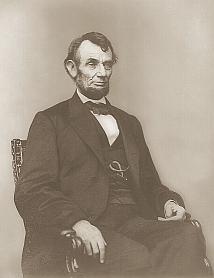
President Abraham Lincoln
“Let us have faith that right makes might; and in that faith let us dare to do our duty as we understand it.”
— Abraham Lincoln, from an address made in New York City on February 21, 1859.
“In giving freedom to the slave we assure freedom to the free, –honorable alike in what we give and what we preserve.”
— Abraham Lincoln, from his Second Annual Message to Congress, December 1, 1862.
“That this nation, under God, shall have a new birth of freedom, and that government of the people, by the people, for the people, shall not perish from the earth.”
— Abraham Lincoln, from the Gettysburg Address which was given at Gettysburg, Pennsylvania on November 19, 1863.
“With malice towards none, with charity for all, with firmness in the right, as God gives us to see the right.”
— Abraham Lincoln, from his Second Inaugural Address, made on March 4, 1865.
“All the armies of Europe, Asia, and Africa combined, with all the treasure of the earth (our own excepted) in their military chest, with a Bonaparte for a commander, could not, by force, take a drink from the Ohio, or make a track on the Blue Ridge, in a trial of a thousand years.”
— Abraham Lincoln, 1837.
“At what point, then, is the approach of danger to be expected? I answer, if it ever reach us, it must spring up amongst us; it cannot come from abroad. If destruction be our lot, we must ourselves be its author and finisher. As a nation of freemen, we must live through all time, or die by suicide.”
— Abraham Lincoln, 1837.
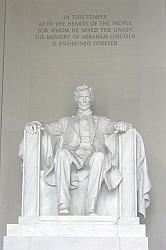
Abraham Lincoln Memorial
“The fight must go on. The cause of civil liberty must not be surrendered at the end of one or even one hundred defeats.”
— Abraham Lincoln, letter to Henry Ashbury, 1858.
“If we do not make common cause to save the good old ship of the Union on this voyage, nobody will have a chance to pilot her on another voyage.”
— Abraham Lincoln, from a speech made in Cleveland, Ohio on February 15, 1861.
“In your hands my dissatisfied fellow-country-men, and not in mine, is the momentous issue of civil war. The government will not assail you.”
— Abraham Lincoln, from his first inaugural address, March 4, 1861.
“My paramount object in this struggle is to save the Union, and is not either to save or destroy slavery. If I could save the Union without freeing any slave, I would do it; and if could save it by freeing all the slaves, I would do it; and if I could save it by freeing some and leaving the others alone, I would also do that.”
— Abraham Lincoln, from a letter to Horace Greely of August 22, 1862. (The Emancipation Proclamation had been written but not yet released.)
“I intend no modification of my oft-expressed personal wish that all men everywhere could be free.”— Abraham Lincoln, from a letter to Horace Greely, August 22, 1862.
“Fellow-citizens, we cannot escape history. We of this Congress and this Administration will be remembered in spite of ourselves. No personal significance or insignificance can spare one or another of us. The fiery trial through which we pass will light us down, in honor or dishonor, to the latest generation.”
— Abraham Lincoln, from his second annual message to Congress on December 1, 1862.
“Only those generals who gain successes can set up dictators. What I ask of you now is military success, and I will risk the dictatorship. …Beware of rashness, but with energy and sleepless vigilance go forward and give us victories.”
— Abraham Lincoln, from a letter he sent to General Joseph Hooker making him commander of the Army of the Potomac, on January 26, 1863.
“Tell me the brand of Whiskey that Grant drinks. I would like to send a barrel of it to my other generals.”
— Abraham Lincoln, in response to news about General Grant’s drinking, November 26, 1863.
 My book 501 Civil War Quotes and Notes features quotes made before, during, and after the Civil War. Each quote has an informative note to explain the circumstances and background of the quote. Learn Civil War history from the spoken words and writings of the military commanders, political leaders, the Billy Yanks and Johnny Rebs who fought in the battles, the abolitionists who strove for the freedom of the slaves, the descriptions of battles, and the citizens who suffered at home. Their voices tell us the who, what, where, when, and why of the Civil War. Available as a Kindle device e-book or as a paperback. Get 501 Civil War Quotes and Notes now!

Love Abraham Lincoln Quotes. Inspirational…