July 1, 1863
General John Buford holds the high ground for the Union at Gettysburg.
John Buford
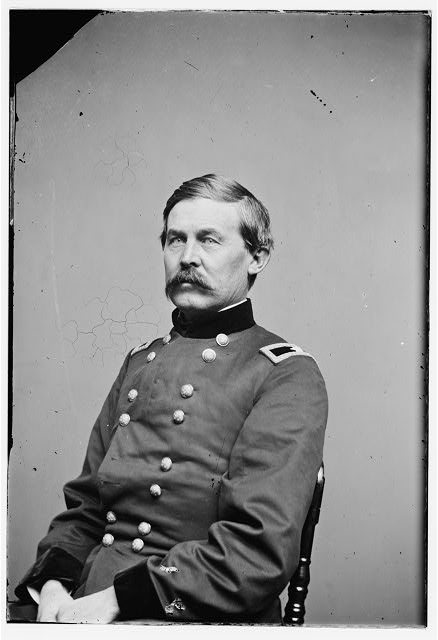
John Buford
“They will attack you in the morning and they will come booming–skirmishers three deep. You will have to fight like the devil until supports arrive.”
…Words of General John Buford at Gettysburg.
The Battle of Gettysburg began when two brigades of unmounted Union cavalry led by John Buford, clashed with Confederate soldiers of General Henry Heth’s division. Buford and his cavalry were reconnoitering ahead of the army in Pennsylvania and discovered the Confederates as they were advancing on Gettysburg. Buford knew the importance of Gettysburg as a transportation junction, and the value of the high ground northwest of town. His cavalry dismounted and held McPherson Ridge for the Union. The resulting skirmish on the outskirts of Gettysburg was the beginning of the three-day Battle of Gettysburg. Without John Buford’s actions early on the first day of the Battle of Gettysburg, the Union may not have triumphed at Gettysburg.
Within six-months of the Battle of Gettysburg, John Buford would die of typhoid fever.
Holding The High Ground
Buford’s clear and quick thinking allowed the Union troops to occupy the high ground of Cemetery Ridge. Part of the reason Buford was able to hold the high ground at Gettysburg is because his unmounted cavalry used Spencer carbine rifles, you may learn more in this post, General John Buford’s Spencer Carbine Rifles.
Holding the high ground was a crucial advantage for the Union during the Battle of Gettysburg. There is a statue today along the Chambersburg Pike at the Gettysburg National Military Park, of General John Buford. Buford’s monument at Gettysburg depicts him standing and looking to the west, holding a pair of field glasses, wearing cavalry boots, with sheathed sword at his side … as he did on July 1, 1863.
A Family History Of Military Service
John Buford was born in Kentucky on March 4th, 1826, but early in life his family moved to Illinois. From age eight, he lived in Rock Island, Illinois. Buford’s father did not support Abraham Lincoln, as he was a politician in the Democratic Party of Illinois. The Buford family had a long history of serving in the military, both Buford’s grandfather and great uncle had fought in the Revolutionary War. Buford had a half-brother who served in the Civil War and became a major general for the Union Army, and he had a cousin who fought for the Confederates as a cavalry brigadier general.
Buford spent only one year at Knox College in Galesburg, Illinois before entering West Point (the United States Military Academy) as a member of the class of 1848. Others attending West Point while Buford was there included classmates who would eventually fight in the Civil War for the Union, such as Fitz-John Porter, George B. McClellan, George Stoneman (Buford and Stoneman would become close friends), and Ambrose Burnside. Others at West Point during Buford’s time there, would fight for the Confederacy, like Thomas Jonathan Jackson (during the Civil War he would obtain the nickname of “Stonewall”), Ambrose Powell Hill, and Henry Heth. Both Powell and Heth would meet against Buford that fateful day of July 1, 1863 at Gettysburg. John Buford graduated from West Point in 1848, and ranked 16th in his class of 38 cadets.
Dragoon Service
After graduation from West Point, Buford started service as a dragoon. He began in the 1st United States Dragoons as a brevet second lieutenant. The following year he went to the 2nd United States Dragoons.
A dragoon soldier uses a horse to get to the battlefield and to move about the battlefield, but he dismounts from the horse in order to fight. This is different from Civil War cavalry because cavalry fight while mounted. This is all in theory however, during the Civil War cavalry were more apt to be performing as mounted infantry. One particular example of a battle fought by mounted cavalry was Brandy Station.
During his dragoon service, Buford was in the Southwest and Texas. He fought the Sioux and was involved with peacekeeping assignments in Kansas during the period of unrest known as Bleeding Kansas. Buford saw action in the western frontier, and during 1857-1858 was part of an expedition in Utah against the Mormons.
The Utah Expedition
In 1857, Mormons living near Salt Lake City, Utah declared they were immune from the laws of the United States. The Mormons would not permit wagon trains on their way to California to pass through their territory, a few groups of wagon trains were slaughtered by the Mormons. The response by the United States was to send troops out to quell the problem. From Fort Leavenworth, the 5th and 10th United States Infantry, and two artillery batteries set out for Utah. The Second United States Dragoons, including John Buford, followed. Getting to Utah however, was not easy. Along the way the Utah Expedition met up with Mormon guerillas, and the hostile environment of the local country made it very difficult to find food and supplies. Cold weather finally made it impossible for the Utah Expedition to continue on.
In November of 1857, Albert Sidney Johnston (during the Civil War, a Confederate general) took command. By the next spring, Johnston had enlarged his force to 5,500 troops, which was over half of the current standing army of the United States. When the Mormons realized what they were now up against, they agreed to peace, United States law, and wagon trains passing through their territory. A significant note of the Utah Expedition is that many future Civil War leaders took part.
John Buford’s Civil War Service And Assignments:
- 2nd Dragoons captain from March 9, 1854.
- 2nd Cavalry captain (this was a renaming that took place on August 3, 1861 of his same role as the 2nd Dragoon’s captain).
- A major, and then promoted to Major Staff Assistant Inspector General beginning November 12, 1861.
- Performed staff duty in 1862 for the defense of Washington, D.C., then joined General Pope’s staff.
- Promoted to brigadier general, United States Volunteers, on July 27, 1862.
- From July 27 to September 12, 1862, commanding Cavalry Brigade, 2nd Corps, Army of Virginia. Buford commanded this brigade during Second Bull Run. This is when John Buford’s abilities as an exceptional cavalry commander were demonstrated. At Second Bull Run (also known as Second Manassas) Buford led a charge, and was struck in the knee by a spent bullet. Buford’s injury was certainly painful, but not life threatening. Nevertheless, some Northern newspapers reported him killed. On August 27, 1862 Buford’s brigade alone opposed the advancement of Longstreet’s corps at Thoroughfare Gap.
- From February 12 to May 22, 1863, commanded the Reserve Brigade, Cavalry Corps, Army of the Potomac. During this time, Buford’s cavalry units fought at Fredericksburg and took part in Stoneman’s Raid during the Chancellorsville Campaign.
- From May 22-27, June 9 – August 15, and September 15-November 21, 1863, Buford commanded the division. Buford commanded at Brandy Station, Aidie, Middleburg, and Upperville.
- Early on July 1, 1863 at Gettysburg, General John Buford saw the tactical importance of holding the high ground for the Union. Northwest of the town of Gettysburg, Buford’s unmounted cavalry engaged the Confederates, until his final defensive stand was made at McPherson’s Ridge. Buford’s men had stalled the Confederate’s advancement, buying valuable time for the arrival of John Reynolds’ Union infantry. The Union now held the high ground of Cemetery Ridge at Gettysburg.
John Buford Gives Up His Command
Becomes A Major General
After Gettysburg, Buford served and fought until the end of the Bristoe Campaign. He became sick with typhoid fever and because of his poor health, Buford gave up his command on November 21, 1863. Buford’s illness was very serious and by the middle of December it was plain he would die.
Buford was on his deathbed at the home of his good and long-time friend, General George Stoneman, in Washington. Stoneman made a proposal on December 16, that John Buford be promoted to major general. President Lincoln wrote: “I am informed that General Buford will not survive the day. It suggests itself to me that he will be made Major General for distinguished and meritorious service at the Battle of Gettysburg.”
When told of this, John Buford was dubious and asked “Does he mean it?” When he was told it was true, Buford replied, “It is too late, now I wish I could live.” Buford died later that afternoon.
Major General John Buford is buried at West Point. Next to Buford’s grave is the grave of Lieutenant Alonzo Cushing. Cushing fell at Gettysburg while fighting to hold Buford’s chosen high ground.
Selected Quotes Of Major General John Buford:
“During the whole campaign, from June 27 to July 31, there has been no shirking or hesitation, to tiring on the part of a single man so far as I have seen; the brigade commanders reported none.”
…John Buford
“Found everybody in a terrible state of excitement on account of the enemy’s advance upon this place.”
…John Buford
“If I have any choice I would prefer Western Troops.”
…John Buford
“Shortly after this, I placed my command on our extreme left, to watch and fight the enemy should he make another attack, and went to Cemetery Hill for observation.”
…John Buford
“The zeal, bravery, and good behavior of the officers and men on the night of June 30, and during July 1, was commendable in the extreme.”
…John Buford
“We entered Gettysburg in the afternoon, just in time to meet the enemy entering the town, and in good season to drive him back before his getting a foothold.”
…John Buford

I Think this is one of the few great pages that honor this great military commander. I am writing my thesis on him and have found some small tidbits from this site that I haven’t found anywhere else! Thank you so much for making High School a bit more bearable!
You are welcome, Shayne. I hope you do well on your thesis.
Best of luck,
Jonathan R. Allen
I realy like this site. It hyas given me more than enough material to finish my report on the greatist military leaders of all time. thank you for the information.
I’m glad you find my LearnCivilWarHistory.com blog helpful, William. Civil War history is interesting and worthwhile to learn.
This is very helpful i am doing a project on john and found info here that i couldn’t find. thanks!
Thank you for teaching me about Buford. My social studies teacher is making us do a project on the Civil War, and I specified on the Battle of Gettysburg to the first battle, which involves John Buford’s Cavalry. Thanks for the help!
I love this website,because it helped me with my biography report that is due March 18,2011!At Brandywine Elem School.Was on this site Thursday March 17 2011 at 6:00 p.m
THANKS!! Samantha
WHAT WAS JOHN BUFORDS BROTHER NAME?
WHO WAS THE CUSIUN OF SAME ?
Napoleon Bonaparte Buford (1807-1883) was John Buford’s half-brother.
Abraham Buford (1820-1884) fought for the Confederate States of America, and was the first cousin of John and Napoleon Bonaparte Buford.
…Jonathan R. Allen
Do you have a listing of the name of Abraham Buford’s battles during the Civil War? Was he married? Any information on his wife and children’s names? Any of his brothers in Civil War? What state was Abraham Buford from prior to Civil War?
I’ve looked at the information I have about John Buford, but there is nothing more regarding Abraham Buford. Can any other readers help Michael R. Van Winkle out?
John Buford was one of the first cavalry leaders in the civil war. This article gives a great overview of hi career. To bid he died so early in life.
Who is his kids??
Hello Priscilla,
John Buford’s wife’s name was Pattie, but in my research I have not found any reference to the Bufords having children.
Buford had two children. His six year-old daughter died from thphoid at the begining of August 1863, soon after Gettysburg. His sister-in-law and father-in-law also died at that time. He recevied 10 days leave of absence to mourn with his family. His other child, a son called James, died in his teens in 1873.
Thank you Robbie Doyle for your comment, you have added some good information about John Buford.