Johnny Clem

John Lincoln Clem
1851 – 1937

In June 1861, a small lad in Newark, Ohio gazed at Union troops marching through his town and despite his too young age, he wanted to join up and fight in the Civil War. The boy’s name was John Joseph Klem.

Earlier, Klem tried to enlist in the 3rd Ohio Infantry, but because of his age and small size, young Klem was turned away. Johnny Clem (he would be known by this name and spelling, later he would be called Johnny Shiloh, and officially he changed his name to John Lincoln Clem) was persistent with his desire to join the army, so he trailed along with the 22nd Massachusetts as it marched through Newark.
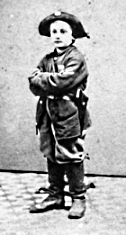
Johnny Clem

Johnny Clem

The 22nd Massachusetts made Clem its mascot and drummer boy. A sawed-off rifle and a small uniform were provided him, and officers of the Massachusetts unit pooled together to pay Johnny the regular soldier’s pay of thirteen dollars a month. Johnny was not yet even 10-years-old, but now he was a drummer (but, not necessarily a good one!), unofficially fighting for the Union.

Two years later, Johnny Clem would be allowed to enlist. On May 1, 1863 Johnny officially became a musician in Company C, 22nd Michigan. A nurse describes Johnny Clem; “was a fair and beautiful child…about twelve years old, but very small for his age. He was only about thirty inches high and weighed about sixty pounds.” Johnny Clem was one of the youngest soldiers for either the Union or Confederate armies, to fight in the Civil War. Johnny would go on to fame in the Civil War, and make the army his career.

It has been common for Johnny Clem to also be known as “Johnny Shiloh.” A story goes that young Clem was at the 1862 Shiloh battle and his drum was broken by an artillery projectile, and then he picked up a gun for the fight. This story was very popular and eventually a poem, a play, and a song were all named “The Drummer Boy of Shiloh.” Clem at Shiloh however, is questionable history.

There were others who claimed to be the actual “The Drummer Boy of Shiloh,” but a study by the National Park Service showed Clem to be the most likely one. Clem’s service indicates he was with the 3rd Ohio, the 22nd Michigan, and the 22nd Wisconsin. The trouble is, is that the 3rd Ohio was not at Shiloh, and the 22nd Michigan, and the 22nd Wisconsin were not organized until after Shiloh. At this time, Johnny Clem was not yet officially a soldier, he was a young boy dressed up as a soldier trying to play the drum. He would not have been reassigned to any units that were at Shiloh. This BlogMaster will leave it up to the reader to decide if Johnny Clem is also Johnny Shiloh. We will see that there is no reason to doubt Johnny Clem’s bravery.

At Chickamauga on September 20, 1863 Johnny Clem rode to the front of the battle on an artillery caisson, carrying along his cut-down rifle. As the course of the battle played out, the Union troops had to retreat and during this a Confederate colonel encountered young Clem and demanded his surrender. Johnny Clem halted as if to comply, but then raised his cut-down rifle at the enemy officer and fired, wounding him.

On learning of Johnny’s exploits, General George H. Thomas promoted Johnny to the rank of lance corporal. Newspapers told Johnny Clem’s story and he gained celebrity status, becoming known as “The Drummer Boy of Chickamauga.”

In October, 1863 Johnny Clem was detailed as a train guard in Georgia when Confederate cavalry captured him. Johnny was freed two months later during a prisoner exchange, but the Confederate newspapers used his capture to ridicule the Union with this barb; “what sore straits the Yankees are driven, when they have to send their babies to fight us.”

Johnny Clem was assigned to General Thomas’s staff as a mounted orderly in January, 1864. During the Atlanta Campaign, young Johnny was twice wounded. On September 19, 1864 he was discharged from the army. President Grant gave Johnny Clem an appointment to West Point, but Johnny had spent his youth and times as a soldier. His lack of formal education prevented him from passing the West Point entrance exam.

President Grant came through for Johnny Clem again by making him a second lieutenant of the 24th Infantry, a unit of black soldiers, in 1871. Johnny thus began his second army term. He advanced to the rank of colonel in the Quartermaster Corps. Clem was able to remain on active duty long enough to become the last Civil War veteran still on duty in the Armed Forces.

John Lincoln Clem completed his military career when he retired in 1916. At his retirement, a special act of Congress made him Major General John Clem. He passed away at age 85, and is buried at Arlington National Cemetery.

A history of the Civil War is incomplete, unless it includes Johnny Clem’s story.
Civil War Speech

Civil War Words, Slang, And Phrases

The soldiers of the Civil War had their own way of saying things. The words, slang, and phrases of Billy Yank (a Union soldier), Johnny Reb (a Confederate soldier), and the civilians of the 19th century are unique and strange to our modern-day ears. The language of Civil War soldiers was rich and colorful, it reflected their lives and times.

It is natural for language to change and develop over time as new words are added to the dictionary. For example, your Learn Civil War History BlogMaster can sometimes be accused of being a mouse potato. The term “mouse potato” is a recent addition to the Merriam-Webster Dictionary. It means I spend too much time at the computer, just as a couch potato spends too much time sitting on the couch watching television.

If you could, can you imagine asking someone from Civil War times what the words Internet and BlogMaster mean! Words also fall from use and become forgotten. Some words used during the Civil War are not often heard or understood today.

Here’s a brief story I’ve written that uses lots of Civil War speech and jargon. See if you can understand what my imaginary Jonathan (a Yankee) soldier is talking about. I’ll translate it further below:

Civil War Jargon

The Latin farmers and I came upon somebody’s darlin, he was from the so-called seceded states and probably a Tar Heel. He had been a snake in the grass, but was now a true lead mine after meeting up with some of us Lincoln hirelings. He was a tough looking butternut, there certainly would have been no social intercourse with him and he looked liked he’d been on partial rations for too long. He was messed up good, a victim of solid shot from a smoothbore, he wasn’t lucky enough to experience a spent ball. Now he would not have to worry about contracting soldier’s disease, or becoming a pickled sardine. Maybe he served under Square Box or Lee’s Old War Horse, maybe too, Little Powell. They all had been through here. We had whipped them good and when the Long-Legged Donkey hears about it he will be glad, yes sir, Long Shanks will be joyful. By the looks of him, he could too have been part of Old Tom Fool’s Lousy 33d, but Old Jack has been sacred dust since Chancellorsville.

Anyway, we were hungry so we sot down for some Lincoln pie, old bull, and coffee, but had no desire to get some lobscouse going. Despite the miasma of this area, we’ll set up a merrimack and break out some oh-be-joyful and get corned. If we get time later on, maybe we’ll have ourselves a louse race. Better get a fire going and try to dry out our mudscows. We should be safe from Old Granny and Old Jubilee tonight. We are proud one-hundred-day-men and serving under Old Four Eyes, as far as we’re concerned there is no one better than Old Snapping Turtle because he is the biggest toad in the puddle. Maybe tomorrow we’ll open the ball. We intend to exfluncticate the graybacks. I snore, I’ll spend all night slapping gallnippers!

I only hope I won’t have to deal with Virginia quickstep tomorrow, like I did today. It sure made things all-overish for me and I almost had a conniption fit dealing with it. Sakes alive, it’s not your funeral. I’ve been like a book here, but I’ll shut pan now.

Translation

The well-educated German immigrants fighting in the Union Army and I came upon an unidentified corpse, he was a Confederate and probably from North Carolina. He had been trying to camouflage himself, but now was dead with several wounds after meeting up with some of us Union soldiers. He was a tough looking Southern soldier, there certainly would have been no pleasant conversation with him and he looked liked he’d been on less than the daily allowance of food for too long. He was messed up good, a victim of chunks of cast iron from a cannon or other firearm without rifling, he wasn’t lucky enough to experience a projectile or bullet that did not have enough velocity to cause any damage. Now he would not have to worry about contracting a chronic ailment suffered by veterans such as morphine or opium addiction, or becoming a prisoner of war who had been imprisoned for many months. Maybe he served under General Thomas Jonathan ’’Stonewall’’ Jackson or General James Longstreet, maybe too, General Ambrose Powell Hill. They all had been through here. We had beat them good and when President Abraham Lincoln hears about it he will be glad, yes sir, Lincoln will be joyful. By the looks of him, he could too have been part of Stonewall Jackson’s 33d Virginia regiment, part of the Army of Northern Virginia, but Stonewall Jackson has been a corpse since Chancellorsville.

Anyway, we were hungry so we sat down for some hardtack, salted horse meat, and coffee, but had no desire to get some stew of hardtack, vegetables, and salted meat going. Despite the unpleasant air of this area, we’ll set up a lean-to for one night’s use and break out some hard liquor and get drunk. If we get time later on, maybe we’ll have ourselves a contest where body lice are placed on the center of a saucer or plate, and wagers are taken as to which louse will scurry and fall of the edge of the plate or saucer first. Better get a fire going and try to dry out our shoes [shoes were also often called brogans]. We should be safe from Confederate Generals Robert E. Lee and Jubal Early tonight. We are proud to be Pennsylvanians who signed up for one hundred days’ service after Gettysburg and serving under General George G. Meade, as far as we’re concerned there is no one better than Meade because he’s the most important person in our group. Maybe tomorrow we’ll start a battle. We intend to utterly destroy the Confederates. I swear, I’ll spend all night slapping large mosquitos!

I only hope I won’t have to deal with diarrhea tomorrow, like I did today. It sure made things uncomfortable for me and I almost had a fit of hysteria dealing with it. Good heavens, it’s none of your concern. I’ve been eloquent here, but I’ll shut up now.

My book 501 Civil War Quotes and Notes features quotes made before, during, and after the Civil War. Each quote has an informative note to explain the circumstances and background of the quote. Learn Civil War history from the spoken words and writings of the military commanders, political leaders, the Billy Yanks and Johnny Rebs who fought in the battles, the abolitionists who strove for the freedom of the slaves, the descriptions of battles, and the citizens who suffered at home. Their voices tell us the who, what, where, when, and why of the Civil War. Available as a Kindle device e-book or as a paperback. Get 501 Civil War Quotes and Notes now!