If you don't have my army supplied, and keep it supplied, we'll eat your mules up, sir.
-- William Tecumseh Sherman's warning to an army quartermaster before the departure of Sherman's army from Chattanooga toward Atlanta.

Eyeball another Civil War quote »


Southern States Secede

Secession fever hit the South after Abraham Lincoln was elected president. The South considered Lincoln's Republican party victory in the 1860 presidential election as a sign that the North was now going to end the "peculiar institution" of slavery. For the South, the time of talk and compromise had ended. In December, 1860 South Carolina became the first state to secede from the Union. Secession of the rest of the states that would make up the Confederate States of America occurred in two waves.
Read More...
Virginia Ordinance of Secession...
The Confederate States of America...


The Sultana Disaster

By Jonathan R. Allen - Last updated: Wednesday, April 27, 2005- Leave a Comment

April 27, 1865

The Sultana is the deadliest maritime tragedy in United States history.


Camp Fisk, near Vicksburg, Mississippi, was a prisoner of war camp holding many Federal prisoners. On April 10, 1865 Confederate authorities sent orders to Camp Fisk for release on parole of all its prisoners. This order came the day after Confederate General Robert E. Lee surrendered the Army of Northern Virginia to General Ulysses Grant at Appomattox Court House, Virginia.

The Union prisoners of war at Camp Fisk previously were prisoners at camps such as Cahaba (Castle Morgan), near Selma, Alabama and at the hellhole known as Andersonville, in Georgia. The majority of these freed prisoners from Camp Fisk had suffered long, hard, imprisonments. The strain of existing in a Civil War prisoner of war camp had taken a toll on these men. They were weak with disease and malnourished, their release from Camp Fisk was a welcomed blessing … and a supposed lifesaver.


The Civil War was ending. The freed prisoners looked forward to shedding their old, worn, filthy war uniforms for new, and soon happily returning to their families and homes. Now on their path to freedom, the parolees would have to make a trip up the Mississippi River from Camp Fisk to Cairo, Illinois.

To move these former prisoners of war up the river to Cairo, the Federal government contracted with private steamboat lines. The steamship Sultana was hired to help transport men.

The Sultana was loaded with over 2,000 parolees and other passengers as it began its voyage to Cairo. This steamship, designed to carry only 376 passengers, was severely and dangerously overloaded. The Sultana had four boilers, and all of them required patching at one time or another. The stress of hauling this overload of human cargo proved too much for the Sultana.


Three Sultana boilers exploded about seven miles above Memphis.
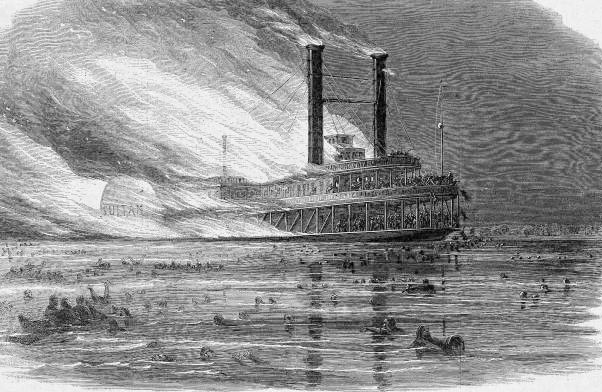
 

The parts of the Sultana not immediately blown to bits in the explosion, soon caught fire. Passengers not killed outright in the explosion now found they were facing flames, or they were thrown into the muddy currents of the Mississippi River.

The freed prisoners were weak and sick from their captivity, many of them did not know how to swim and were injured by the boiler explosions. The final fate for many, after surviving cruel prisoner of war captivity, was drowning in the Mississippi.


  Barnes&Noble: Sultana
Sultana
 

The figures vary, but 783 to 786 people were rescued from the muddy Mississippi waters. Those saved from the water were taken to Memphis hospitals. Sadly, 200 of them later died from their ordeal. Estimates are that between 1,500 and 1,700 people died because of the Sultana explosion.

The remnants of the Sultana explosion drifted down the Mississippi River, eventually sinking opposite the city of Memphis. Today, the Sultana’s remnants are buried deep in mud at the bottom of the Mississippi River.


More people died in the Sultana explosion, than died when the Titanic sank in April of 1912.

Print Friendly
Share

Suggested Posts to Learn More...

Write a comment


Add Comment


Follow CivilWarHistory on Twitter


Subscribe

RSS Feed
RSS
Subscribe

Future Posts

First Lines Color Key

Gold = antebellum
Green = 1861
Navy = 1862
Purple = 1863
Orange = 1864
Red = 1865
Brown = postbellum
Cyan = Other

Barnes&Noble Has Civil War Books, CDs, DVDs

BarnesandNoble.com Logo - 120x60

Civil War Top 100

Civil War Top 100

facebook

Learn Civil War History

Promote Your Page Too

Twitter

Follow Me on Twitter!
Follow CivilWarHistory

EzineArticles Platinum Expert Author

Jonathan R. Allen, EzineArticles.com Platinum 
Author
Links I Like ...

First Lines Color Key

Gold = antebellum
Green = 1861
Navy = 1862
Purple = 1863
Orange = 1864
Red = 1865
Brown = postbellum
Cyan = Other

Monthly Archives

Civil War Posters and Prints

Confederate General Robert E. Lee in 1862 or 1863
Confederate...

12 in. x 16 in.
Buy This at Allposters.com


General Ulysses S. Grant
General Ulysses...

Buy This at Allposters.com


General William T. Sherman
General William...

12 in. x 16 in.
Buy This at Allposters.com


Battle of Gettysburg
Battle of...
C.d. Graves
12 in. x 9 in.
Buy This at Allposters.com
Welcome

RSS Feed The purpose of this Civil War blog is to help you Learn Civil War History. You are invited to read about a crucial time in the history of the United States: the Civil War. Any and all aspects of the Civil War will be subjects on this blog. Battles, leaders, soldiers, civilians, abolitionists, slaves, freed slaves, politics, politicians, civilians and their lives during the war, equipment, animals, cavalry, infantry, artillery, medicine, Rebels and Yankees, heroes, villains, and scoundrels... and all other topics of the Civil War will be discussed. Your comments and thoughts are always welcome. The Civil War is a rich, broad, fascinating, and interesting subject to learn about. So, join me and Learn Civil War History!
-- Jonathan R. Allen
BlogMaster.
A sister website of
www.nellaware.com.

"The histories of the Lost Cause are all written out by big bugs, generals and reknowned historians. Well, I had as much right as any man to write a history."
-- Sam Watkins, of Company H, 1st Tennessee of Nashville.

And He shall judge among the nations, and shall rebuke many people; and they shall beat their swords into plowshares, and their spears into pruning-hooks. Nation shall not lift up sword against nation, neither shall they learn war any more.
(Isaiah 2:4)

Popular Posts

Categories

Recent Entries

BlogMaster Picks


The History Channel, A&E, and Biography


The American Civil War DVD Set


The Hunley Secrets Revealed DVD


Lincoln: His Life and Legacy DVD Set