Doctor Samuel Alexander Mudd

Doctor Samuel Alexander Mudd was the physician who treated assassin John Wilkes Booth’s broken left leg after Booth shot President Abraham Lincoln. Booth had broken his leg when he leapt onto the stage from the presidential box at Ford’s Theatre after shooting Lincoln in the back of his head. Booth then fled on horseback.

Early the next morning on April 15, 1865 Booth and David Herold, an accomplice in the assassination, had made their escape into Maryland where they called on Dr. Samuel Mudd to treat Booth’s broken leg. Mudd was an acquaintance of the well-known and popular actor Booth. Booth and Herold then stayed briefly at the Mudd house before continuing on in their escape to Virginia. John Wilkes Booth was eventually shot dead by pursuing Union soldiers in a Virginia barn.

In 1865, a jury of Army officers convicted Mudd and seven others in the plot to assassinate President Abraham Lincoln. David Herold was one of the four hanged (along with Mary E. Surratt, Lewis T. Powell, and George A. Atzerodt) on July 7, 1865 for conspiracy in Abraham Lincoln’s assassination.

Dr. Samuel Mudd was found guilty of conspiracy but was spared the hangman’s noose by one jury vote. Dr. Samuel Mudd was sentenced to life imprisonment at Fort Jefferson. Fort Jefferson, with sweltering conditions of heat and humidity, was a harsh place to be imprisoned, it being approximately 70 miles west of Key West, Florida in the Dry Tortugas. President Andrew Johnson pardoned Mudd in February, 1869 and on March 8, 1869 Dr. Samuel Mudd was freed from the prison. During Dr. Mudd’s time at Fort Jefferson he helped stop the spread of a yellow fever epidemic that had ravaged through the prison.

There has been continuing controversy about whether or not Dr. Samuel Mudd was involved in the assassination conspiracy, or was only a country doctor helping a man with a broken leg. Doctor Mudd’s guilt or innocence, in the assassination of Abraham Lincoln is still debated.

In 1992 an administrative board of the Army made the recommendation that Mudd’s conviction be expunged because Mudd was a civilian. However, following Army secretaries and a federal judge, turned down this recommendation. A court decision in November, 2002 dismissed an attempt to have expunged the 1860s military commission conviction of Dr. Samuel Mudd.

Thomas Mudd is the grandson of Samuel Mudd, and he plans to seek a review of the 2002 court decision by the full appeals court. If this fails, Thomas Mudd intends to ask the United States Supreme Court to intervene.

Dr. Samuel Mudd was absolved by President James Earl “Jimmy” Carter in 1979 of involvement in the conspiracy to assassinate President Abraham Lincoln. It is a curiosity that the former television anchorman Roger Mudd, is related to Dr. Samuel Mudd.
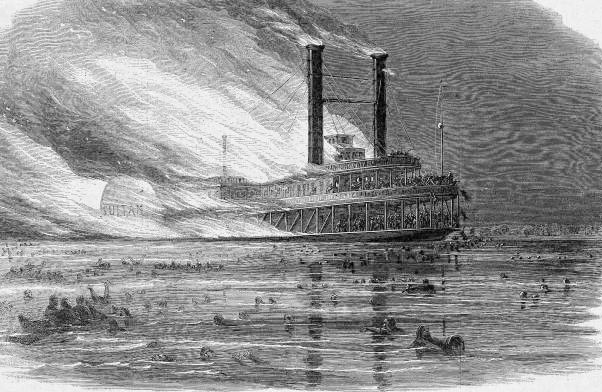
The Sultana Disaster

The Sultana is the Deadliest Maritime Tragedy in United States History

April 27, 1865

Camp Fisk Prisoners Of War Camp

Camp Fisk, near Vicksburg, Mississippi, was a prisoner of war camp holding many Federal prisoners. On April 10, 1865 Confederate authorities sent orders to Camp Fisk for release on parole of all its prisoners. This order came the day after Confederate General Robert E. Lee surrendered the Army of Northern Virginia to General Ulysses Grant at Appomattox Court House, Virginia.

The Union prisoners of war at Camp Fisk previously were prisoners at camps such as Cahaba (Castle Morgan), near Selma, Alabama and at the hellhole known as Andersonville, in Georgia. The majority of these freed prisoners from Camp Fisk had suffered long, hard, imprisonments and the strain of existing in a Civil War prisoner of war camp had taken a toll on their health. They were weak with disease and malnourished, their release from Camp Fisk was a welcomed blessing … and a supposed lifesaver.

The Civil War was ending. The freed prisoners looked forward to shedding their old, worn, filthy war uniforms for new, and soon happily returning to their families and homes. Now on their path to freedom, the parolees would have to make a trip up the Mississippi River from Camp Fisk to Cairo, Illinois.

The Sultana Used To Transport Freed Prisoners Of War

To move these former prisoners of war up the river to Cairo, the Federal government contracted with private steamboat lines. The steamship Sultana was hired to help transport men.

The Sultana was loaded with over 2,000 parolees and other passengers as it began its voyage to Cairo. The Sultana was severely and dangerously overloaded as this steamship was designed to carry only a mere 376 passengers. There were four boilers in the Sultana and all of them required patching at one time or another. The stress of hauling this overload of human cargo proved too much for the Sultana.

Three Sultana boilers exploded about seven miles above Memphis.

The Sultana Disaster

The Sultana Disaster

What parts of the Sultana that were not immediately blown to bits by the explosion, soon caught fire. The passengers who were not killed outright in the explosion now found they were facing flames or they were thrown into the muddy currents of the Mississippi River.

The freed prisoners were weak and sick from their captivity, many of them did not know how to swim and were injured by the boiler explosions. For many of these poor men, men who had survived cruel prisoner of war captivity and treatment, their final fate was drowning in the Mississippi.

The figures vary, but 783 to 786 people were rescued from the muddy Mississippi waters. Those saved from the water were taken to Memphis hospitals. Sadly, 200 of them later died from their ordeal. Estimates are that between 1,500 and 1,700 people died because of the Sultana explosion.

The remnants of the Sultana explosion drifted down the Mississippi River, eventually sinking opposite the city of Memphis. Today, the Sultana’s remnants are buried deep in mud at the bottom of the Mississippi River.

More people died in the Sultana explosion, than died when the Titanic sank in April of 1912.