Alexander Stephens

Alexander Hamilton Stephens: February 11, 1812 – March 4, 1883

“A little, slim, pale-faced consumptive man just concluded the very best speech of an hour’s length I ever heard.”
–Illinois Congressman Abraham Lincoln describing Alexander Hamilton Stephens of Georgia after Stephens completed a speech to Congress. Lincoln and Stephens became friends while they served in Congress before the Civil War, but later slavery ended their friendship. During the Civil War, Stephens was the vice president of the Confederacy.

Little Aleck
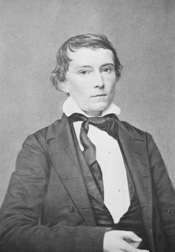
Alexander Stephens

Alexander Stephens

Alexander Stephens was never a picture of health. He was 5′ 7″, a height in line with the norms of the 19th century, but only carried about ninety-pounds on his frame, he was pale and sickly. From birth, he was small, and during his childhood was given the nickname of “Little Aleck.” Stephens suffered many maladies including angina, bladder stones, colitis, migraine headaches, pneumonia, pruritus, arthritis, and sciatica. The word cadaverous would come to mind when seeing Alexander Stephens. He clothed himself layer upon layer trying to stay warm, and once defined his idea of happiness as; “To be warm.

Despite Stephens’s sickly body, behind his dark eyes he was blessed with a brilliant mind. His childhood was a difficult one, Stephens’s mother died soon after he was born, then his farmer and schoolteacher father died when Little Aleck was 14-years-old. Fortunately, a few benevolent mentors realized the potential of the highly intelligent young Stephens and funded his education at Franklin College (later to become the University of Georgia). Alexander Stephens finished at the top of his class at Franklin College.

Stephens became a lawyer and owned a plantation named Liberty Hall. If there can be such as thing as a good master, then perhaps Stephens was. He never beat or whipped his slaves, and he never split slave families apart. None of his slaves tried to escape, perhaps a testament of his care for them. Nonetheless, Stephens held human beings captive as slaves on his Georgia plantation and profited from their bondage.

Congressman

Alexander Stephens served in the United States Congress for 17 years and became an authority on the Constitution. Though he had an odd, girl-like, high voice, his brightness brought him fame as an orator. Stephens was a moderate Unionist and voted against Georgia’s secession. When Georgia did leave the Union, out of honor Stephens chose the South.

The new Confederate Congress met in Montgomery, Alabama (later Richmond, Virginia became the Confederate Capital) in February, 1861 to establish the foundation of the Southern country. Although he at first was opposed to disunion, Alexander Stephens was a favorite to become the president, but he lost that position to Jefferson Davis. Instead, Stephens became the vice president of the Confederate States of America.

On December 22, 1860 Abraham Lincoln wrote a letter marked as “For Your Eyes Only” to Georgia Congressman Alexander Stephens. In this letter Lincoln, before taking office, is telling Confederate Vice President Stephens in a private, personal letter, that he has no plans for his Republican administration to interfere with slavery:

The South would be in no more danger in this respect, than it was in the days of Washington. I suppose, however, this does not meet the case. You think slavery is right and ought to be extended; while I think it is wrong and ought to be restricted. That I suppose is the rub.

Stephens had been a Unionist, but he was also loyal to the South. A moderate, he was a supporter of a peaceful resolution between the North and the South, he hoped to avoid war. Seeing that it was inevitable, he became a supporter of secession.

As the South formed its government at the Montgomery Convention, Alexander Stephens contributed significantly to the creation of the Confederate Constitution. He chaired the Rules Committee and also the Committee on the Executive Departments.

Cornerstone Speech

Stephens gave what is known as his Cornerstone Speech on March 21, 1861 at Savannah, Georgia. This speech is probably what Stephens is best known for. In this speech, Stephens fundamentally lays out what the conflict between the North and the South is all about. One sentence (that gives the speech its name) of this extemporaneous speech stands out as the definition of the Confederate cause and what its government stood for:

Our new government is founded upon exactly the opposite idea; its foundations are laid, its corner- stone rests, upon the great truth that the negro is not equal to the white man; that slavery subordination to the superior race is his natural and normal condition.
— Vice President of the Confederacy, Alexander Hamilton Stephens.

With these words from his Cornerstone Speech, Alexander Stephens is stating in a nutshell the reason for secession … slavery. In our modern world of today, these words by Stephens are shocking and ugly. His words are so contrary to our times, that it may be necessary to read them twice, to see if what you thought he said, is really what he said. Stephens’s words show the way it was back in Civil War times. Because of this cornerstone difference between the North and the South, a brutal war of brother against brother was fought.

Soon there was conflict between Vice President Stephens and President Jefferson Davis. As Stephens was a moderate, he disagreed with Davis over various topics. The two Confederate leaders did not get along. Stephens refused to go on several missions that Davis wanted him to make. Finally, Davis had to order Stephens to go to the still independent state of Virginia as a Confederate commissioner.

Stephens remained a strong supporter of state sovereignty, so he disagreed with Davis over the Confederate draft and the suspension of the writ of habeas corpus. Alexander Stephens continued to support negotiated peace, this gave Davis an edge in weakening Stephens’s strength within the Confederate government. Stephens’s role in the Davis administration was minimal and he felt that Davis ignored whatever advice or council he offered. For months at a time, Little Aleck was absent from Richmond, he would be at his Liberty Hall plantation in Georgia, avoiding the problems and cares of the Confederate government.

Peace Missions

Davis was able to get Stephens out of Georgia long enough to send him on a peace mission to Washington to meet with President Lincoln in 1863. It was Stephens’s idea that by June, 1863, with the success of Southern armies, and the “failure of Hooker and Grant,” (in Stephens’s words) that the timing was right for peace negotiations. Alexander Stephens offered to meet with President Lincoln, his old pre-war friend from their days in Congress, under a flag of truce to talk about prisoner-of-war exchanges. It was hoped that this tact of approach might lead to discussion of peace. Jefferson Davis liked the idea and gave Stephens instructions that limited his powers to prisoner exchanges.

On July 3, 1863 Stephens took a boat down the James River, on his way to Washington to meet with President Abraham Lincoln and to hopefully discuss peace. Also on that July 3 day, at a town named Gettysburg, the Army of Northern Virginia led by General Robert E. Lee suffered a climatic loss to General George G. Meade’s Army of the Potomac.

President Jefferson Davis was expecting a Confederate victory at Gettysburg and thought that as the Army of Northern Virginia was approaching Washington from the north, that Vice President Stephens would be approaching from the south … and with good timing, they both might arrive at the same time. President Lincoln would then have a choice (and either way, the Union loses), discuss peace negotiations with Stephens, or suffer conquest by Robert E. Lee.

Things flip-flopped fast. The Union won at Gettysburg, President Lincoln got word at the same time of the Union battlefield victory, and that Confederate Vice President Stephens was coming to Washington on a mission. Lincoln sent word that refused a request of Stephens’s to pass through the lines under a flag of truce. Lincoln thought if the Confederacy wanted to discuss prisoner-of-war exchanges, then there were military ways for that. The fortunes of war had changed and Stephens’s mission was for naught.

Alexander Stephens met with President Lincoln in another peace attempt, at the Hampton Roads Peace Conference on February 3, 1865 as the Civil War was soon coming to an end. Confederates Stephens, Senator Robert M. T. Hunter, and Judge John A. Campbell met with Lincoln and Secretary of State William Seward on board the steamer River Queen in Hampton Roads.

The three Confederates wanted Southern independence, Lincoln and Seward refused any plan that continued slavery. For Little Aleck, this meeting proved to be a total failure. Jefferson Davis knew that this meeting would prove fruitless for Alexander Stephens, and humiliate him. Stephens had to return to Richmond for a report of the meeting’s failure to the Confederate Congress, thus proving that Stephens’s interests in a negotiated peace were impossible.

Postbellum

At the end of the Civil War, Stephens was imprisoned at Boston’s Fort Warren. The year after being released from prison he was elected as a United States Senator of Georgia, but was denied his seat in Washington. Afterwards, Little Aleck bought the Atlanta Southern Sun, and wrote A Constitutional View of the Late War, in this 2 volume book he was critical of Jefferson Davis.

Stephens’s public service was not yet complete, he returned to the United States House of Representatives from 1873 to 1882. He was elected as governor of Georgia, but died within only a few months of taking office.

Alexander Hamilton Stephens is buried at his Liberty Hall plantation near Crawfordville, Georgia.

Alexander Stephens Quotes:

We are without doubt on the verge, on the brink of an abyss into which I do not wish to look.
–Alexander Stephens, after Abraham Lincoln was elected president on November 6, 1860.

This step, secession, once taken, can never be recalled. We and our posterity shall see our lovely South desolated by the demon of war.
–Alexander Stephens, January 18, 1861.

It will probably end the war.
–Alexander Stephens, regarding the secession of Virginia from the Union on April 17, 1861.

We shall be in one of the bloodiest civil wars that history has recorded.
–Alexander Stephens after Fort Sumter.

War I look for as almost certain … Revolutions are much easier started than controlled, and the men who begin them … themselves become the victims.
–Alexander Stephens, 1861.

General John Buford’s Spencer Carbine Rifles

Spencer Carbines Helped John Buford’s Unmounted Cavalry Hold The High Ground

…Or Did Buford’s Cavalry Use A Different Carbine?

Gettysburg, July 1, 1863.

As General John Buford’s unmounted cavalry held the high ground for the Union on July 1, 1863, on the outskirts of Gettysburg, they had a technological advantage over the Confederates they were fighting.

There has been confusion and debate about whether or not John Buford’s unmounted cavalry had Spencer carbines on the morning of July 1, 1863, at Gettysburg. Were they using breech-loading Spencer carbine rifles or other weapons? No matter which particular weapon they used, their weapons allowed the Union men to fire at a rate comparable to a larger unit of men. Buford’s strategic deployment and positioning of his unmounted cavalry that early July 1, morning at Gettysburg also contributed greatly to the Union holding the high ground.

Here, I will give a few arguments both pro and con about Buford’s men having Spencer carbines the first day of Gettysburg.

It may be worth noting the Definition of CARBINE:
1: a short-barreled lightweight firearm originally used by cavalry
2: a light short-barreled repeating rifle that is used as a supplementary military arm or for hunting in dense brush
Source: Merriam-Webster online dictionary. http://www.merriam-webster.com/dictionary/carbine

Did General John Buford’s Cavalry Have Spencer Carbine Rifles?

Readers of this blog will notice this post has generated some comments with discussion and controversy, regarding whether or not John Buford’s cavalry had Spencer carbines on the first day of the Battle of Gettysburg, or if they had another type of carbine.

Below, we have two opposing views on this matter and a post update with more explanation.

For the sake of argument, I’ll provide the view supporting Buford having Spencer carbines at Gettysburg, and Professor John Vogt of Newman University in Wichita, Kansas, provides us the viewpoint that Buford did not have Spencer carbines at Gettysburg.

I think both points of view are worthy of consideration as both are backed up by credible sources. Sometimes history is messy.

In the end, I’ll leave it up to the reader to decide for him or herself regarding John Buford’s use or non-use of Spencer carbines/rifles on the first day of the Battle of Gettysburg. If anyone has information to add, then please contribute!

I thank Professor Vogt for his contribution to www.learncivilwarhistory.com.

BUFORD’S CAVALRY COULD NOT HAVE HAD SPENCER CARBINES AT GETTYSBURG

The history of the Spencer company is chronicled in the book, ‘Spencer Repeating Firearms’ by Roy Marcot (Irvine, CA: Northwood Heritage Press, 1983). This well-regarded but out-of-print work appears on the Smithsonian list of Selected Bibliography on Firearms (http://www.si.edu/Encyclopedia_SI/nmah/firearms.htm) and is an indispensable resource for anyone interested in Spencer firearms. Tony Beck has relied on it heavily for his article ‘Spencer Carbines’ (http://www.civilwarguns.com/spencer1.html).

Marcot’s impeccable research leaves little room for doubt. The first Spencer carbines were delivered in early October 1863 (Marcot, pgs 66-67.) Whatever repeaters Buford’s men might have had that first day of July in 1863, they were not Spencer carbines!

Prof. John Vogt
Newman University
Wichita, KS

Post Update

On July 1-3, 2017 the Civil War Trust held a number of Live Events on its Facebook page. During the live feeds, Civil War Trust historians gave talks as they walked noted areas of the Gettysburg battlefield. Those who were watching the live Facebook feeds were invited to ask questions. I took the opportunity to ask if John Buford’s cavalry had Spencer carbines the early morning of July 1, 1863, at Gettysburg.

Here are the replies of noted Civil War and Gettysburg historians Garry Adelman and Wayne Motts:

Garry Adelman: “Somebody asked. I think it was Jonathan, whether Buford’s men had Spencer carbines. […] People say that all of Buford’s men Spencers, [that] all of Buford’s men had Henry Repeating rifles, and things like that. Wayne set us straight.”

Wayne Motts: “Well, the record shows, from ordnance records we have here, that most of Buford’s command had the standard weapon the cavalry be issued in the Civil War. That’s going to be Burnside, that’s going to be Sharps carbines. Sharps carbines is going to be the principal weapon that Buford is going to have here on July 1st, 1863. So, they did not have repeating weapons although that’s a myth that almost won’t die that Garry and I deal with on a daily basis.”

Here is a link to the Civil War Trust’s Facebook page:
Civil War Trust Facebook Page

Look for the replay of the Facebook Live Event which was live on July 1, 2017, at 9:30 a.m. titled:
Civil War Trust Facebook Live: The First Day’s Outer Line-McPherson’s Ridge to Barlow’s Knoll with Garry Adelman, Wayne Motts, and Kristopher White.

My question is answered at approximately the -17:00 mark of the replay.

What The Civil War Trust Does In The Trust’s Own Words

“The Civil War Trust is the largest and most effective nonprofit organization devoted to the preservation of America’s hallowed battlegrounds. Although primarily focused on the protection of Civil War battlefields, the Trust also seeks to save the battlefields connected to the Revolutionary War and War of 1812. Through educational programs and heritage tourism initiatives, the Trust seeks to inform the public about the vital role these battlefields played in determining the course of our nation’s history.”

Here is a link to the Civil War Trust’s website:
Civil War Trust

Garry Adelman is Director of History and Education for the Civil War Trust.

Wayne Motts is the CEO of The National Civil War Museum in Harrisburg, Pennsylvania. He is also a Licensed Battlefield Guide at Gettysburg National Military Park.


JOHN BUFORD HAD SPENCER CARBINES AT GETTYSBURG

In addition to sources I have provided further below in my reply comment to Mr. Ken James, I’ll quote some passages from the book They Met at Gettysburg by General Edward J. Stackpole (Harrisburg, Pennsylvania: Stackpole Books, 1956).

From pages 55-56, Stackpole is writing about the Affair at Hanover which occurred on June 30, 1863. Near Hanover, there was a skirmish between Stuart’s cavalry and a squadron of Yankee cavalry that was part of Judson Kilpatrick’s cavalry division.

The first passage I’ll use from my source is to support and setup the second passages I’ll use. Here we see, according to Stackpole, that Spencers were in use by Federal cavalry in June, 1863 during the Gettysburg campaign:

“Stuart’s weary troopers were in no condition to contest the right of way with the Federal cavalry, whose new lease on life and improved morale had recently been given a special fillup with the issue of the new Spencer rifle, a seven-shot repeating arm that was the equivalent of at least quadrupled manpower for dismounted fighting.

“The 6th Michigan and 1st West Virginia Cavalry regiments, of Custer’s and Farnsworth’s brigades respectively, are known to have been recently armed with the Spencer repeater, and both were engaged with Stuart’s troopers in the Hanover skirmish. Whether they used their Spencers effectively from horseback is questionable, but the fact remains that Kilpatrick definitely blocked Stuart from the two roads leading north from Hanover to Carlisle.”

Now, quoted below are various passages from pages 120-122 of the section Buford’s New Tactics from Stackpole’s book that I believe support the argument of Buford having Spencers at Gettysburg. I’ll include some passages that talk about Buford’s style, and background of fighting with cavalry, which I think are interesting and pertinent to how Buford and his cavalry fought at Gettysburg:

“For his part Buford considered the saber to be of little practical value. He thought of the horse as a means of transportation, useful chiefly because of the greatly increased mobility which it gave to the mounted troops. He treated the cavalry as mounted infantry, and instilled that belief in his brigade and later his division, until it became practically instinctive. The procedure was to move rapidly to a critical position and dismount the troops to quickly form an infantry skirmish line while one out of every four men became horseholder for the group, under cover to the immediate rear, ready at all times for the set of fours to remount in an instant and gallop off to a new position.[…]

“[…] The extent to which the Spencer seven-shot repeating rifle contributed to Buford’s success in Virginia is not entirely clear, but careful researching in the last few years has uncovered material which may cause historians to reappraise the relative cavalry capabilities of the opposing sides and the resulting impact on Civil War campaigns and battles following Chancellorsville.** What is certain is that Buford’s cavalry division was armed in part with the repeater before leaving Virginia for the Gettysburg campaign and concurrently several regiments of Kilpatrick’s division received an issue of the same new weapon prior to their fight with Stuart at Hanover on June 30. It is therefore not difficult to imagine the superior firepower that the Federal cavalry was enabled to bring to bear against the Confederates who in the main were still forced to rely on their muzzle-loading single shot muskets both at Hanover and at Gettysburg on the morning of the first day.”
**J. O. Buckeridge, Lincoln’s Choice, The Stackpole Company, Harrisburg, 1956.


The Firepower Of The Spencer

Following are videos demonstrating the difference between loading and firing a Civil War musket, and a Spencer carbine. The musket must be reloaded after each firing, while the Spencer could fire seven times before a reload. In the heat of a battle, which one would you prefer to have?

Civil War Musket Shooting Demo

This is a demonstration of the steps, and time, required to load and fire a musket. A Civil War soldier would be loading and firing faster than in this demonstration.


Shooting An Antique Spencer Carbine

In the below video, the gentleman fires the Spencer three times. I don’t think he is particularly skilled or fast with his firing, but we’ll cut him some slack because the video’s explanation text indicates: “Shooting a Model 1865 Spencer Carbine. First trial after converting it to centre-fire so it can use available ammunition.” So, he may only be doing some test firing after converting the rifle to centre-fire. You will notice that between the first and second shots he fumbles somewhat with the cocking. A Civil War soldier would not want to do that, that small fumble may cost him his life.


Shooting The 1865 Spencer Rifle

A dramatic demonstration of a Spencer carbine at work. In this video, you’ll see how a Spencer was loaded using a tube magazine that could hold seven rounds. All seven rounds could be fired in under a minute. Confederates called the Spencers; “the damnyankee rifles you could load on Sunday and fire all week.”


Further Reading

If you perform a Google search for “john buford spencer carbines” there will be about 2,280,000 results. Some of the search result web pages will provide information that supports John Buford having Spencer carbines on July 1, 1863, at the Battle of Gettysburg, and some web page search results will say the contrary. Here are only a few of the search results:

Information Supporting That John Buford Had Spencer Carbines

Spencer Carbine

Buford Hold the High Ground

Google Books: American Civil War: The Definitive Encyclopedia and Document Collection

Battle of Gettysburg

Information Not Supporting That John Buford Had Spencer Carbines

The Guns Of Gettysburg

Weapons at Gettysburg – The Spencer Repeating Rifle

Book review: “The Devil’s to Pay”: John Buford at Gettysburg. A History and Walking Tour

More Gettysburg Information

Learn More About John Buford

Gettysburg, The First Day

Gettysburg, The Second Day

Gettysburg, The Third Day