George B. McClellan Quotes

George Brinton McClellan – The Young Napoleon
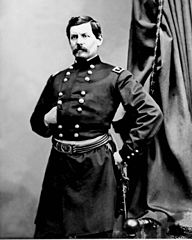
George_B_McClellan

George B. McClellan The Young Napoleon

Early in the Civil War, General George B. McClellan provided needed leadership to the Union military efforts with his organization, administration, and training of men in the rapidly growing and forming army. This was very important at the time and McClellan’s abilities were much-needed. He provided a great service to the inexperienced, raw, and untamed army with his preparation and organizational skills. However, as the war progressed McClellan was ineffectual and unsuccessful at actually taking an army to battle. For President Abraham Lincoln, George B. McClellan was a continual source of frustration because of his inability or unwillingness to move the army and have it do what an army exists to do… which is to fight and defeat the enemy.

George B. McClellan seemed destined for greatness. He was the son of a distinguished Philadelphia doctor and finished second in his class at West Point. In the Mexican War he earned three brevets for gallant and meritorious conduct. Later, he spent a year in Europe and a report he wrote of his observations of foreign military methods brought him acclaim and recognition. Captain McClellan resigned from the United States Army in 1857, and began a career in business. He became vice president of the Illinois Central Railroad where he met a tall, country bumpkin lawyer who represented the railroad. This rough-hewn lawyer’s name was Abraham Lincoln. McClellan looked down on Lincoln, considering Lincoln his inferior both socially and intellectually. Another influential man George B. McClellan met during his railroad times was Allan Pinkerton, who was working as a contract private detective of the railroad. McClellan, Lincoln, and Pinkerton were all destined for importance and greater things when the Civil War came.

With the start of the Civil War, George B. McClellan began as a Major General of Ohio volunteers, then became Major General of the Regular Army and having command of the Department of the Ohio. McClellan was only 35-years-old. During the first year of the Civil War, he’d achieved prominence with Union victories at Rich Mountain and Carrick’s Ford in western Virginia (This part of Virginia would later become the Union State of West Virginia.). McClellan seemed to have the world by the tail. After Irvin McDowell’s defeat at Bull Run, President Lincoln replaced McDowell with McClellan as the commander of the Division of the Potomac, made up of the armies around Washington. General Winfield Scott soon retired as general in chief, and Abraham Lincoln gave George B. McClellan that title and responsibility as well as being the commander of the Army of the Potomac. McClellan told Lincoln: “He could do it all.

Soon it was apparent to President Lincoln that although George B. McClellan could prepare an army for war, he had no plans, ability, or inclination to actually lead an army into war. Because of his strong skills at organizing and motivating an army, McClellan was dubbed with praiseworthy monikers such as; “The Young Napoleon” and “Little Mac,” but McClellan was always finding fears and reasons not to move the army towards the enemy. McClellan would claim that the army did not have enough supplies, that the horses are too tired, that he needed more and more troops, that his army was vastly outnumbered by the enemy, (Allan Pinkerton, who was now McClellan’s personal secret operative, contributed to this fear and reason for delay of McClellan’s. Pinkerton would often overestimate the number of enemy forces, sometimes by as much as three times their actual number.) and on and on with more and more reasons for delay and more preparation. With McClellan, there was always a reason not to move forward towards the Rebels and engage them in battle.

Instead of considering George B. McClellan as “The Young Napoleon” or “Little Mac,” others had a more critical and disparaging opinion of the arrogant, conceited, strong-willed, constantly delaying, and unmoving McClellan. They referred to him as: “McNapoleon.”

Quotes By and About George B. McClellan

“The true course in conducting military operations, is to make no movement until the preparations are complete.”
–George B. McClellan, while preparing in Washington.

“Who would have thought, when we were married, that I should so soon be called upon to save my country?”
–George B. McClellan’s words from a letter to his wife. President Abraham Lincoln had made George Brinton McClellan commander of the Division of the Potomac after First Bull Run.

“By some strange operation of magic I seem to have become the power of the land.”
–George B. McClellan said this of himself shortly after he assumed command of the Union forces around Washington in 1861.

“All quiet along the Potomac.”
–Attributed to General George B. McClellan, c. 1861.

“Will you pardon me for asking what the horses of your army have done since the battle of Antietam that fatigues anything?”
–President Abraham Lincoln’s question directed to George B. McClellan, who had excused his lack of action in the fall of 1862 because of exhausted horses. McClellan was removed from command soon afterward.

“If he had a million men he would swear the enemy has two millions, and then he would sit down in the mud and yell for three.”
–Edwin M. Stanton, the United States secretary of war commenting on General George B. McClellan. McClellan often overestimated the number of enemy forces opposing him, and so he always needed and wanted more men and more supplies before he could take offensive action.

It is called the Army of the Potomac, but it is only McClellan’s bodyguard…If McClellan is not using the army, I should like to borrow it for a while.
–Abraham Lincoln on April 9, 1862, regarding George B. McClellan. McClellan often tested Lincoln’s patience because of his failure to take action against the Confederates. This quote is from a note Lincoln eventually decided not to send.

General McClellan, if I understand you correctly, before you strike at the Rebels, you want to be sure of plenty of room so you can run in case they strike back.
–This is from Zachariah Chandler, a member of the Joint Committee on the Conduct of the War as he was questioning McClellan regarding his inability to take offensive movement against the Rebels.

McClellan’s vice…was always waiting to have everything just as he wanted before he would attack, and before he could get things arranged as he wanted them, the enemy pounced on him.
–Union General George G. Meade regarding General George B. McClellan. McClellan was a brilliant organizer and administrator, and he had good strategic sense. His organizational skills as a commander were badly needed to whip the army into shape early in the war. His training of the Union armies for war is highly regarded.

“Stand by General Burnside as you have stood by me and all will be well.”
–George B. McClellan’s advice to his troops after being replaced by Burnside in November of 1862.

The effect of this man’s presence upon the Army of the Potomac–in sunshine or in rain, in darkness or in daylight, in victory or defeat–was electrical, and too wonderful to make it worthwhile attempting to give a reason for it.
–Anonymous comments regarding Union General George B. McClellan. McClellan was loved by his troops and he staged grand reviews to improve the morale of the men. He made the men of the army proud.

“He went beyond the formal military salute, and gave his cap a little twirl, which with his bow and smile seemed to carry a little personal good fellow-ship to the humblest private soldier…It was very plain that these little attentions to the troops took well, and had no small influence in establishing a sort of comradeship between him and them.”
–A Union officer describing General George B. McClellan. The soldiers believed in McClellan, they thought he was the one who would lead them to victory.

“He has got an eye like a hawk. I looked him right in the eye and he done the same by me.”
–A Union soldier from Massachusetts commenting on General George B. McClellan. The soldiers of the Army of the Potomac called him “Little Mac” and in the press he was called “Young Napoleon.”

“Sending armies to McClellan is like shoveling fleas across a barnyard. Not half of them get there.”
–Abraham Lincoln expressing his frustration and dissatisfaction with General George George B. McClellan.

“Action, action is what we want and what we must have.”
–George Brinton McClellan, 1862.

“I regard it as certain that the enemy will meet us with all his force on or near the Chickahominy…If I am not re-enforced, it is probable that I will be obliged to fight nearly double my numbers, strongly entrenched.”
–George B. McClellan on May 10, 1862.

“I feel sure of success, so good is the spirit of my men and so great their ardor. But I am tired of the battlefield, with its mangled corpses and poor wounded. Victory has no charms for me when purchased at such a cost.”
–George B. McClellan on June 2, 1862.

“I prefer Lee to Johnston. The former is too cautious and weak under grave responsibility–personally brave and energetic to a fault, he yet is wanting in moral firmness when pressed by heavy responsibility and is likely to be timid and irresolute in action.”
–Union General George B. McClellan sizing up Confederate General Robert E. Lee.

“McClellan will make this a battle of posts. He will take position from position, under cover of his heavy guns. I am preparing a line that I can hold with part of our forces in front, while the rest I will endeavor to make a diversion to bring McClellan out.”
–Confederate General Robert E. Lee’s thoughts and plans for handling Union General George B. McClellan in June, 1862.

“The spectacle yesterday was the grandest I could conceive of. Nothing could be more sublime. Those on whose judgement I rely tell me that I fought the battle splendidly, and that it was a masterpiece of art.”
–George B. McClellan commenting on his own performance at the Battle of Antietam. Antietam was not a tactical victory for the North.

“I will hold McClellan’s horse if he will only bring us success.”
–Abraham Lincoln in 1862. Abe would be holding that horse for a long time while waiting for success from George B. McClellan. When McClellan failed to pursue Robert E. Lee after Antietam, Abraham Lincoln made Ambrose Burnside commander of the Army of the Potomac.
My book 501 Civil War Quotes and Notes features quotes made before, during, and after the Civil War. Each quote has an informative note to explain the circumstances and background of the quote. Learn Civil War history from the spoken words and writings of the military commanders, political leaders, the Billy Yanks and Johnny Rebs who fought in the battles, the abolitionists who strove for the freedom of the slaves, the descriptions of battles, and the citizens who suffered at home. Their voices tell us the who, what, where, when, and why of the Civil War. Available as a Kindle device e-book or as a paperback. Get 501 Civil War Quotes and Notes now!
John Brown Quotes

“I, John Brown am now quite certain that the crimes of this guilty land will never be purged away but with blood.”

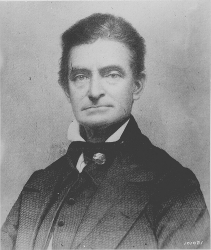
John Brown was the “The meteor of the war,” as author Herman Melville called him. John Brown was an abolitionist, and a religious fanatic. Some say that John Brown is a martyr. Brown believed he was an instrument of God.

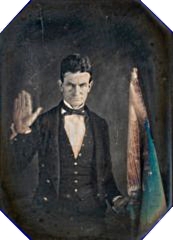
Abolitionist John Brown in 1856.

Abolitionist John Brown in 1856.

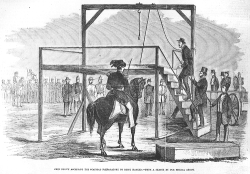
Before the Civil War began, Brown’s abolitionist actions stirred and heated the boiling cauldron of events leading to the war. In May of 1856, John Brown and four of his sons shot and hacked to death five pro-slavery settlers at Pottawatomie Creek, Kansas. In 1859, Brown and a band of 21 men seized the United States Armory at Harpers Ferry, Virginia. Brown was hanged for this on December 2, 1859 at Charles Town, Virginia. John Brown’s Gallows’ site can still be toured today in Charles Town, West Virginia.

It should be noted that West Virginia became the 35th state of the Union on June 20, 1863. At the time of John Brown’s activities at Harpers Ferry, this part of West Virginia still belonged to the state of Virginia.

John Brown Quotes

I have only a short time to live, only one death to die, and I will die fighting for this cause. There will be no peace in this land until slavery is done for.“– John Brown, Kansas Territory, 1856.

Talk, is a national institution, but it does not help the slave.” — John Brown.

Caution, Sir! I am eternally tired of hearing that word caution. It is nothing but the word of cowardice!
— John Brown, discussing matters with a neighbor, after the neighbor saw a need to give warning to John Brown.

I don’t think the people of the slave states will ever consider the subject of slavery in its true light till some other argument is resorted to other than moral persuasion.
— Abolitionist John Brown’s words of October, 1859. On December 2, 1859 John Brown was hanged for treason after seizing the United States Armory at Harpers Ferry – part of Brown’s plan to present “some other argument” to the slave states.

When I strike, the bees will begin to swarm, and I want you to help hive them.
— John Brown’s words to Frederick Douglass before Brown’s raid on Harpers Ferry in October, 1859. Brown did strike, but unfortunately for him, the “bees” never did begin to swarm. The United States Marines, commanded by Robert E. Lee, did swarm and ended Brown’s siege of Harpers Ferry.

Had I so interfered in behalf of the rich, the powerful, the intelligent, the so-called great, or in behalf of their friends…and suffered and sacrificed what I have in this interference…every man in this court would have deemed it worthy of reward rather than punishment.
— John Brown, speaking on November 2, 1859 during his sentencing.

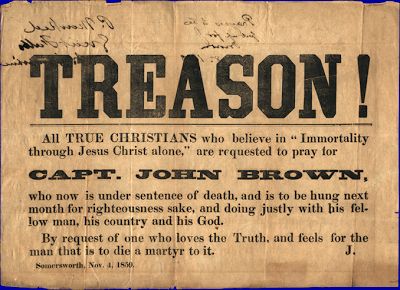
TREASON! Capt. John Brown

TREASON! Capt. John Brown

If it is deemed necessary that I should forfeit my life for the furtherance of the ends of justice, and mingle my blood further with the blood of my children and with the blood of millions in this slave country whose rights are disregarded by wicked, cruel, and unjust enactments-I submit; so let it be done.
— John Brown, speaking on November 2, 1859 during his sentencing. John Brown would be hanged.

I have been whipped, as the saying is, but I am sure I can recover all the lost capital occasioned by that disaster; by only hanging a few moments by the neck; and I feel quite determined to make the utmost possible out of a defeat.
— John Brown, to his wife. On December 2, 1859 John Brown was hanged by the neck (and perhaps for more than “a few moments”) for treason.

This is a beautiful country.
— Spoken by John Brown while seated on his coffin, as he rode to his execution on the gallows.

I, John Brown am now quite certain that the crimes of this guilty land will never be purged away but with blood.
— John Brown said nothing on the gallows, but handed a note containing these words to a guard. The outbreak of the Civil War in April, 1861 proved John Brown prophetic.

John Brown’s Address To The Virginia Court Before His Death Sentence

John Brown’s trial began only ten days after his capture at Harpers Ferry. Brown and his men were charged by the state of Virginia with murder, treason, and inciting a slave insurrection. There was no doubt as to what John Brown’s fate would be. John Brown would hang. It took the jury only forty-five minutes to find John Brown guilty as charged. Brown’s sentencing was set for November 2, 1859. At his sentencing John Brown was asked if he had anything to say as to why his sentencing should not be pronounced. He stood and responded:

I have, may it please the Court, a few words to say.

In the first place, I deny everything but what I have all along admitted, the design on my part to free slaves. I intended certainly to have made a clean thing of that matter, as I did last winter, when I went into Missouri and there took slaves without the snapping of a gun on either side, moved them through the country, and finally left them in Canada. I designed to have done the same thing again, on a larger scale. That was all I intended. I never did intend murder, or treason, or the destruction of property, or to excite or incite slaves to rebellion, or to make insurrection.

I have another objection; and that is, it is unjust that I should suffer such a penalty. Had I interfered in the manner which I admit, and which I admit has been fairly proved–for I admire the truthfulness and candor of the greater portion of the witnesses who have testified in this case,–had I so interfered in behalf of the rich, the powerful, the intelligent, the so-called great, or in behalf of any of their friends, either father, mother, brother, sister, wife, or children, or any of that class, and suffered and sacrificed what I have in this interference, it would have been all right; and every man in this court would have deemed it an act worthy of reward rather than punishment.

John Brown

John Brown

This court acknowledges, as I suppose, the validity of the Law of God. I see a book kissed here which I suppose to be the Bible, or at least the New Testament. That teaches me that, “All things whatsoever I would that men should do to me, I should do even so to them.” It teaches me, further, to “Remember them that are in bonds, as bound with them.” I endeavored to act up to that instruction. I say, I am yet too young to understand that God is any respecter of persons. I believe that to have interfered as I have done as I have always freely admitted I have done in behalf of His despised poor, was not wrong, but RIGHT.

Now, if it is deemed necessary that I should forfeit my life for the furtherance of the ends of justice, and MINGLE MY BLOOD FURTHER WITH THE BLOOD OF MY CHILDREN and with the blood of millions in this slave country whose rights are disregarded by wicked, cruel, and unjust enactments, I submit; so LET IT BE DONE!

Let me say one word further: I feel entirely satisfied with the treatment I have received on my trial. Considering all the circumstances. it has been more generous than I expected. But I feel no consciousness of guilt. I have stated from the first what was my intention and what was not. I never had any design against the life of any person, nor any disposition to commit treason, or excite slaves to rebel, or make any general insurrection. I never encouraged any man to do so, but always discouraged any idea of that kind.

Let me say, also, a word in regard to the statements made by some of those connected with me. I hear it has been stated by some of them that I have induced them to join me. But the contrary is true. I do not say this to injure them, but as regretting their weakness. There is not one of them but joined me of his own accord, and the greater part of them at their own expense. A number of them I never saw, and never had a word of conversation with, till the day they came to me; and that was for the purpose I have stated. Now I have done.

Does reading about Civil War history from long and dry academic-like books bog you down and cause you to lose interest? Would you like to read interesting stories based on facts of the Civil War, stories that inform you and move along with the war’s history? Does having to read from cover to cover tire you and cause you to drag through a history book? Would you prefer the freedom to skip around in a book and learn story-by-story about the Civil War? If you answered “yes” to any of these questions, then the factual stories in 125 Civil War Stories and Facts will help you learn Civil War history. The stories are informative and entertaining and it’s a fun way to learn about the Civil War. Do books like Civil War Trivia and Fact Book by Webb Garrison or The Civil War: Strange & Fascinating Facts by Burke Davis interest you? Then you will find 125 Civil War Stories and Facts follows in their tradition of providing the reader with rich and interesting information about the Civil War. Available as a Kindle device e-book or as a paperback. Get 125 Civil War Stories and Facts now!


Quotes about John Brown

So perish all such enemies of Virginia! All such enemies of the Union! All such foes of the human race!
— Colonel Preston of the Virginia militia said these words to the crowd that had gathered to see John Brown hang. A member of the Virginia militia who was present, was an actor named John Wilkes Booth. Booth would later make tragic history in April of 1865. Also in the crowd were cadets from the Virginia Military Institute led by Thomas J. Jackson, later to be known as “Stonewall Jackson” of the Confederacy.

Hanging from the beam,
Slowly swaying (such the law),
Gaunt the shadow on your green,
Shenandoah!
The cut is on the crown
(Lo, John Brown),
And the stabs shall heal no more.

— Herman Melville, “The Portent.”

John Brown died on a scaffold for the slave; Dark was the hour when we dug is hallowed grave; Now God avenges the life he gladly gave, Freedom reigns today!
— This is called “The President’s Proclamation” and you should sing it using the tune from “Battle Hymn of the Republic.”

Old John Brown…agreed with us thinking slavery wrong. That cannot excuse violence, bloodshed, and treason. It could avail him nothing that he might think himself right.
— Abraham Lincoln

John Brown at the gallows.

John Brown at the gallows.

And Old Brown
Old Osawatomie Brown,
May trouble you more than ever, when you’ve
nailed his coffin down!

— Anderson’s “A Voice From Harpers Ferry.” Earlier in his abolitionist career, John Brown was in Osawatomie, Kansas and there he murdered five pro-slavery men with help from four of his sons. This was Brown’s response to the pro-slave raid made on Lawrence, Kansas in 1856.

Nobody was ever more justly hanged.
— Nathaniel Hawthorne on John Brown.

You rejoiced at the occasion, and were only troubled that there were not three times as many killed in the affair. You were in evident glee-there was no sorrow for the killed nor for the peace of Virginia disturbed-you were rejoicing that by charging Republicans with this thing you might get an advantage on us.
— Abraham Lincoln, March 6, 1860. Lincoln was referring to the Democrat opinion of John Brown’s raid on Harpers Ferry in 1859.

The murderer and robber & fire-raiser so notorious for these crimes in his Kansas career, & now the attempter of the thousand-fold horrors in Virginia, is, for these reasons, the present idol of the north.
— Edmund Ruffin, November of 1859. Ruffin is referring to John Brown, the fanatic abolitionist. Ruffin was a strong secessionist and is credited with firing the first shot at Fort Sumter, but this fact can be questioned. On June 15, 1865 after the Civil War had come to an end, Ruffin committed suicide by shooting himself “because he was unwilling to live under the US government.”

The result proves that the plan was the attempt of a fanatic or madman.
— Lieutenant Colonel Robert E. Lee commenting on John Brown’s raid upon Harper’s Ferry.

The meteor of the war.
— Herman Melville (Moby Dick author) on John Brown.

My book 501 Civil War Quotes and Notes features quotes made before, during, and after the Civil War. Each quote has an informative note to explain the circumstances and background of the quote. Learn Civil War history from the spoken words and writings of the military commanders, political leaders, the Billy Yanks and Johnny Rebs who fought in the battles, the abolitionists who strove for the freedom of the slaves, the descriptions of battles, and the citizens who suffered at home. Their voices tell us the who, what, where, when, and why of the Civil War. Available as a Kindle device e-book or as a paperback. Get 501 Civil War Quotes and Notes now!
 

Learn Civil War History Podcast – Episode One: John Brown Quotes

Anchor

Spotify


LearnCivilWarHistory.com presents this excellent rendition of John Brown’s Body by gloriajane1 for your enjoyment. Thank you gloriajean1 and best wishes.

John Brown’s Body

gloriajane1 | September 29, 2009 | 4:29

Back around the time that Christians, abolitionists, free blacks, anti-slavery activists and Kansas land owners first formed the Republican party, John Brown an abolitionist and baptist preacher, gave his life to put an end to slavery. During the civil war northern soldiers sang this old song as they marched off to battle. After “Julia Ward Howe” heard Union troops singing this, the original version of the song, she wrote her own words to it’s tune. Soon after, her version was published in the “Atlantic Monthly” as “The Battle Hymn Of The Republic”…gloriajane1


Virginia Historical Society: John Brown’s Raid in American Memory