November 19, 1863
Abraham Lincoln gives a speech to dedicate a cemetery at Gettysburg, Pennsylvania. A speech that “won’t scour.”
A Few Appropriate Remarks
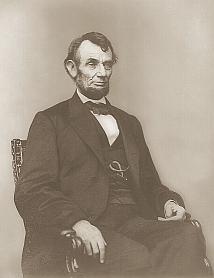
President Abraham Lincoln
President Lincoln received the below invitation from the organizers of the new cemetery’s dedication ceremony. The invitation asks President Lincoln if, after another speaker has given his speech, he would say “a few appropriate remarks” for the occasion.
“It is the desire that after the oration, you, as Chief Executive of the nation, formally set apart these grounds to their sacred use by a few appropriate remarks.”
Lincoln was not the main speaker at this cemetery dedication. Edward Everett was the keynote speaker, he was a famed orator and supporter of the Union cause. Everett spoke for two hours at Gettysburg.
A Page Of Ordinary Paper
Here is a description of the events at Gettysburg that November day, according to a Philadelphia journalist named John Russell Young:
“The procession from town was a ragged affair. We all seemed to get there as best we could. A crude platform looked out over the battlefield. On one side sat the journalists; the eminent people had the other side. When the President arose, he stood for an instant, waiting for the cheers to cease, slowly adjusted his glasses and took from his pocket what seemed to be a page of ordinary paper, quietly unfolded it and began to read.”
Abraham Lincoln began his “few appropriate remarks” at Gettysburg. His speech was brief.
The Gettysburg Address
“Four score and seven years ago our fathers brought forth on this continent, a new nation, conceived in Liberty, and dedicated to the proposition that all men are created equal.
“Now we are engaged in a great civil war, testing whether that nation, or any nation so conceived and so dedicated, can long endure. We are met on a great battle-field of that war. We have come to dedicate a portion of that field, as a final resting place for those who here gave their lives that that nation might live. It is altogether fitting and proper that we should do this.
“But, in a larger sense, we can not dedicate — we can not consecrate — we can not hallow — this ground. The brave men, living and dead, who struggled here, have consecrated it, far above our poor power to add or detract. The world will little note, nor long remember what we say here, but it can never forget what they did here. It is for us the living, rather, to be dedicated here to the unfinished work which they who fought here have thus far so nobly advanced. It is rather for us to be here dedicated to the great task remaining before us — that from these honored dead we take increased devotion to that cause for which they gave the last full measure of devotion — that we here highly resolve that these dead shall not have died in vain — that this nation, under God, shall have a new birth of freedom — and that government of the people, by the people, for the people, shall not perish from the earth.”
Polite Applause
Lincoln’s speech at Gettysburg lasted about only two minutes and he spoke a mere 272 words. The gathered crowd applauded Lincoln politely, but without much enthusiasm.
Lincoln was displeased with his effort. After he completed his short speech of a few appropriate remarks, Lincoln in his frontier manner of speech, said to Ward Hill (Lamon in the following quote) who had introduced him during the dedication:
“Lamon, that speech won’t scour. It is a flat failure.”
Later, Lincoln would also have this self-criticism of his speech at Gettysburg saying:
“I failed, I failed, and that is about all that can be said about it.”
Flat And Dishwatery Utterances
Others too, were unhappy with Lincoln’s words at Gettysburg. The Chicago Tribune newspaper wrote:
“The cheek of every American must tingle with shame as he reads the silly, flat and dishwatery utterances of the man who has to be pointed out to intelligent foreigners as the President of the United States.”
Eloquent Simplicity
However, not all thought so poorly of Lincoln’s words at Gettysburg as Lincoln and the Chicago Tribune did. John Hay was Abraham Lincoln’s assistant private secretary. Hay wrote in his diary entry for November 19, 1863:
“The President, in a fine, free way, with more grace than is his wont, said his half dozen words of consecration.”
Edward Everett wrote these words of praise to Lincoln:
“Permit me also to express my great admiration of the thoughts offered by you, with such eloquent simplicity & appropriateness, at the consecration of the cemetery. I should be glad, if I came as near to the central idea of the occasion, in two hours, as you did in two minutes.”
Everett realized the worth of Lincoln’s speech at Gettysburg.
Lincoln was still not convinced his speech had scoured. His reply to Everett:
“In our respective parts yesterday, you could not have been excused to make a short address, nor I a long one. I am pleased to know that, in your judgment, the little I did say was not entirely a failure.”
The Gettysburg Address is one of the greatest speeches ever made. Abraham Lincoln’s “few appropriate remarks” at Gettysburg scoured fine.
Abraham Lincoln, Gettysburg Address from the movie ‘Saving Lincoln’

Pingback: Tweets that mention Gettysburg Address -- Topsy.com