“For every Southern boy fourteen years old…”
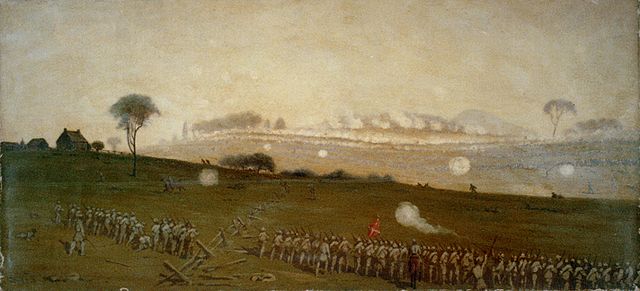
Pickett’s Charge
“It’s all now you see. Yesterday won’t be over until tomorrow and tomorrow began ten thousand years ago. For every Southern boy fourteen years old, not once but whenever he wants it, there is the instant when it’s still not yet two o’clock on that July afternoon in 1863, the brigades are in position behind the rail fence, the guns are laid and ready in the woods and the furled flags are already loosened to break out and Pickett himself with his long oiled ringlets and his hat in one hand probably and his sword in the other looking up the hill waiting for Longstreet to give the word and it’s all in the balance, it hasn’t happened yet, it hasn’t even begun yet, it not only hasn’t begun yet but there is still time for it not to begin against that position and those circumstances which made more men than Garnett and Kemper and Armistead and Wilcox look grave yet it’s going to begin, we all know that, we have come too far with too much at stake and that moment doesn’t need even a fourteen-year-old boy to think This time. Maybe this time with all this much to lose and all this much to gain: Pennsylvania, Maryland, the world, the golden dome of Washington itself to crown with desperate and unbelievable victory the desperate gamble, the cast made two years ago; or to anyone who ever sailed a skiff under a quilt sail, the moment in 1492 when somebody thought This is it: the absolute edge of no return, to turn back now and make home or sail irrevocably on and either find land or plunge over the world’s roaring rim.”
… William Faulkner
From his book: Intruder in the Dust, 1948.
Learn Civil War History Podcast: William Faulkner’s Pickett’s Charge Quote
Pickett’s Charge
Ken Burns – The Civil War
 My book 501 Civil War Quotes and Notes features quotes made before, during, and after the Civil War. Each quote has an informative note to explain the circumstances and background of the quote. Learn Civil War history from the spoken words and writings of the military commanders, political leaders, the Billy Yanks and Johnny Rebs who fought in the battles, the abolitionists who strove for the freedom of the slaves, the descriptions of battles, and the citizens who suffered at home. Their voices tell us the who, what, where, when, and why of the Civil War. Available as a Kindle device e-book or as a paperback. Get 501 Civil War Quotes and Notes now!