What Happened In The Civil War During 1861?
The Civil War began in 1861 when the Rebels fired upon Fort Sumter. Some other major events of 1861 are: Abraham Lincoln is inaugurated as the 16th president of the United States, the Southern states secede from the Union, the Confederate States of America’s government is formed with Jefferson Davis as its president, Robert E. Lee resigns from the United States Army and decides to fight for the South, both North and South begin to fill their armies by calling for volunteers, United States General-In-Chief Winfield Scott proposes his Anaconda Plan, the Border States are established, the First Battle of Bull Run (First Manassas) is fought, George B. McClellan becomes commander of the Army of the Potomac, Ulysses S. Grant has command of Federal troops in southeastern Missouri and southeastern Illinois, William Tecumseh Sherman has a short time of command in the eastern and central parts of Kentucky, Ball’s Bluff is a Union disaster, Winfield Scott is replaced by George B. McClellan as general-in-chief, and the Trent Affair causes diplomatic problems for the Union.
January
“I cannot comprehend the madness of the times. Southern men are theoretically crazy. Extreme northern men are practical fools, the latter are really quite as bad as the former. Treason is in the air around us every where & goes by the name of Patriotism.”
… Words of Thomas Corwin to Abraham Lincoln on January 16, 1861.
1–6 – During this stretch of dates Southern state militias are busy. Fort Pulaski in Savannah, Georgia, two forts and an arsenal in Alabama, and a United States Arsenal in Apalachicola, Florida, are all occupied by state militias.
5 – A caucus is held by United States senators from six gulf states and Arkansas. Their conclusion is that reconciliation is only a waste of time, and that the slave states should secede and form a confederacy.
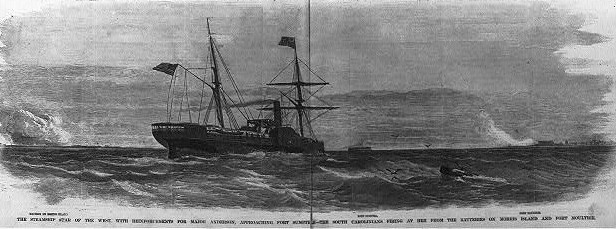
Star of the West
5 – The Star of the West is loaded with 200 troops and provisions as it leaves New York. The ship is sailing to Fort Sumter in Charleston Harbor, South Carolina to provide relief for the troops on duty there.
8 – Jacob Thompson resigns his position as the Mississippi Secretary of the Interior.
9 – The Star of the West has made its way to the South Carolina coast, but rebel fire prevents the ship from entering Charleston Harbor, it returns to New York.
“The first gun of the new struggle for independence [if struggle there is to be] has been fired, and Federal power has received its first repulse.”
… An excerpt from an editorial by the Charleston Mercury on January 10, 1861.
9 – Mississippi secedes from the Union.
10 – Florida secedes from the Union.
11 – Alabama secedes from the Union.
19 – Georgia secedes from the Union.
“The day that Georgia was declared out of the Union was a day of the wildest excitement in Rome [Rome, Georgia]. There was no order or prearrangement about it all, but the people met each other and shook hands and exchanged congratulations over it and manifested the utmost enthusiasm. Of course, a great many of the older and wiser heads looked on with a great deal of foreboding at these rejoicings and evidence of delight, but the general feeling was one of excitement and joy.”
… Georgian Mary A. Ward speaking before Congress after the war.
19 – In an attempt to stave off secession, the state of Virginia proposes a national peace conference.
21 – The United States Senate loses five more members from the South (others had resigned in December, 1860) as they resign. Notable among these resigning senators is Jefferson Davis of Mississippi.
26 – Louisiana secedes from the Union.
29 – After losing five states to secession, the new state of Kansas is admitted as the thirty-fourth state of the Union. The Kansas state constitution prohibits slavery.
February
“Upon my weary heart was showered smiles, plaudits, and flowers, but beyond them, I saw troubles and thorns innumerable. We are without machinery, without means, and threatened by a powerful opposition; but I do not despond and will not shrink from the task imposed on me.”
… Jefferson Davis, the provisional president of the Confederate States of America, writes to his wife, Varina, in February, 1861.
1 – Texas secedes from the Union.
“I am for the Union without any ‘if.’”
… Unlike others in his state, Texas Governor Sam Houston was not in favor of secession.
4 – Virginia’s national Peace Convention opens in Washington, D.C. with former President John Tyler presiding. There are 131 delegates from 21 states in attendance, but there are no delegates present from the seceded states. The convention is boycotted by states of the Deep South.
4 – The six seceded states begin to organize as they meet at a convention in Montgomery, Alabama to create their new government. The seceded states at this time are: South Carolina, Florida, Alabama, Georgia, Mississippi, and Louisiana.
8 – At the Montgomery convention, the seceded states adopt a Constitution for their provisional government.
9 – The provisional Confederate Congress at Montgomery elects Jefferson Davis of Mississippi as the provisional Confederate President, and Alexander Stephens of Georgia as the Confederate provisional Vice-President.
“Mr. Davis is a man of slight sinewy figure, rather over the middle height, and of erect, soldierlike bearing. He is about fifty-five years of age; his features are regular and well-defined, but the face is thin and marked on cheek and brow with many wrinkles, and is rather careworn and haggard. One eye is apparently blind, the other is dark, piercing, intelligent.”
… A description of Jefferson Davis by William Russell of the London Times.
“You cannot transform the negro into anything one-tenth as useful or as good as what slavery enables them to be.”
… Words of Jefferson Davis, the provisional president of the Confederate States of America. February, 1861.
9 – A secession convention up for vote in Tennessee is rejected by nearly ten thousand votes.
10 – In Springfield, Illinois, a tall man named Abraham Lincoln leaves on his journey to Washington, D.C., and his place in history.
13 – The Electoral College confirms Abraham Lincoln’s election as President of the United States.
15 – Now that it has provisional President Jefferson Davis and provisional Vice-President Alexander Stephens, the Montgomery, Alabama Confederate convention acts as a provisional Congress and passes a resolution to take Union-held Fort Sumter in Charleston Harbor, South Carolina and Fort Pickens in Pensacola Beach, Florida. The resolution says that if necessary, force can be used to take these forts.
18 – Jefferson Davis is inaugurated as the provisional President of the Confederacy.
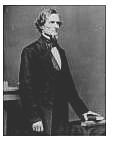
Jefferson Davis
“The man and the hour have met. Prosperity, honor and victory await his administration.”
… Fire-eater William Lowndes Yancy introducing Jefferson Davis to an enthusiastic crowd. Yancy was one of the South’s most vocal proponents for secession.
23 – Abraham Lincoln completes his journey from Springfield, Illinois when he arrives in Washington, D.C., he has many challenges awaiting him.