Clara Barton Spent Her Life Helping And Serving Others
A young lad is badly injured when he falls from the rafters of a barn at North Oxford, Massachusetts in 1832. His name is David, and the fall makes him an invalid. Young David will spend the next two years recovering from his injuries and during this time his eleven-year-old sister stays by his bedside nursing him back to health. The sister’s name was Clara, and this was the beginning of Clara Barton’s life of caring for and helping others.
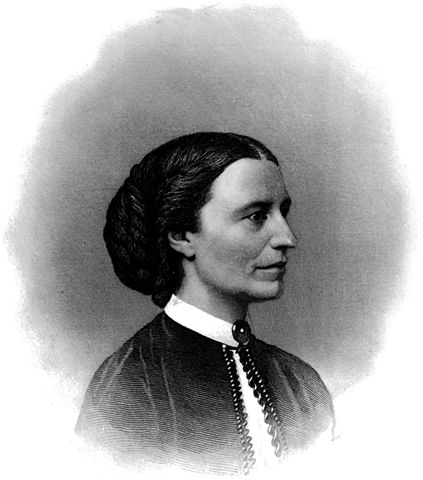
Civil War Nurse Clara Barton
Clara Barton was born on Christmas day in 1821 and like her four older siblings, Clara’s schooling was at home. At age fifteen she becomes a schoolteacher and then later she starts a free public school in Bordentown, New Jersey. Clara Barton would spend her life aiding and serving others. During the Civil War, Clara Barton becomes known as “The Angel of the Battlefield.”
When the Civil War began in 1861, Clara Barton was working for the United States Patent Office and living in Washington, D.C. The women working at the Patent Office before the Civil War were known as “government girls” as they were part of the growing Federal government. These women had jobs that were previously held only by men. When the Civil War began, these “government girls” lost their jobs.
The Baltimore Riot occurs on April 19, 1861 when Massachusetts and Pennsylvania militia making their way to Washington are attacked by secessionists in Baltimore. Four militiamen and twelve citizens are killed. Clara Barton starts a relief program for the 6th Massachusetts Regiment when it arrives at Washington.
Barton advertised in the Worcester, Massachusetts, Spy newspaper for donations when she learned after First Bull Run that the injured men did not have adequate medical supplies for their needs. Clara started an independent organization to distribute the collected supplies. Her efforts were successful, and the next year Clara Barton was granted a general pass by United States Surgeon General William A. Hammond to travel along with the army ambulances. Hammond’s pass said Barton’s presence with the ambulances was: “for the purpose of distributing comforts for the sick and wounded, and nursing them.” Clara accepted this pass, but she was somewhat reluctant to do so, she was afraid she might be confused as one of the women who made it a habit of following the army – but not for the good, and higher purposes like her’s.
After Second Bull Run, Clara Barton was part of the volunteer nurses United States Secretary Edwin M. Stanton called for to help the troops spread along the defeated Union line of retreat. She gathered and solicited wagonloads of food and needed medical supplies, taking them to the troops on the front lines. Barton would aid the injured and sick, and make soup and coffee.
“The men were brought down from the field till they covered acres. By midnight there must have been three thousand helpless men lying in that hay…. All night we made compresses and slings – and bound up and wet wounds, when we could get water, fed what we could, traveled miles in that dark over to those poor helpless wretches, in terror lest some one’s candle fall into the hay and consume them all.”
— Clara Barton writing of her experiences tending to the injured men after Second Bull Run. Barton had helped spread bales of hay onto the ground for the men to lay on.
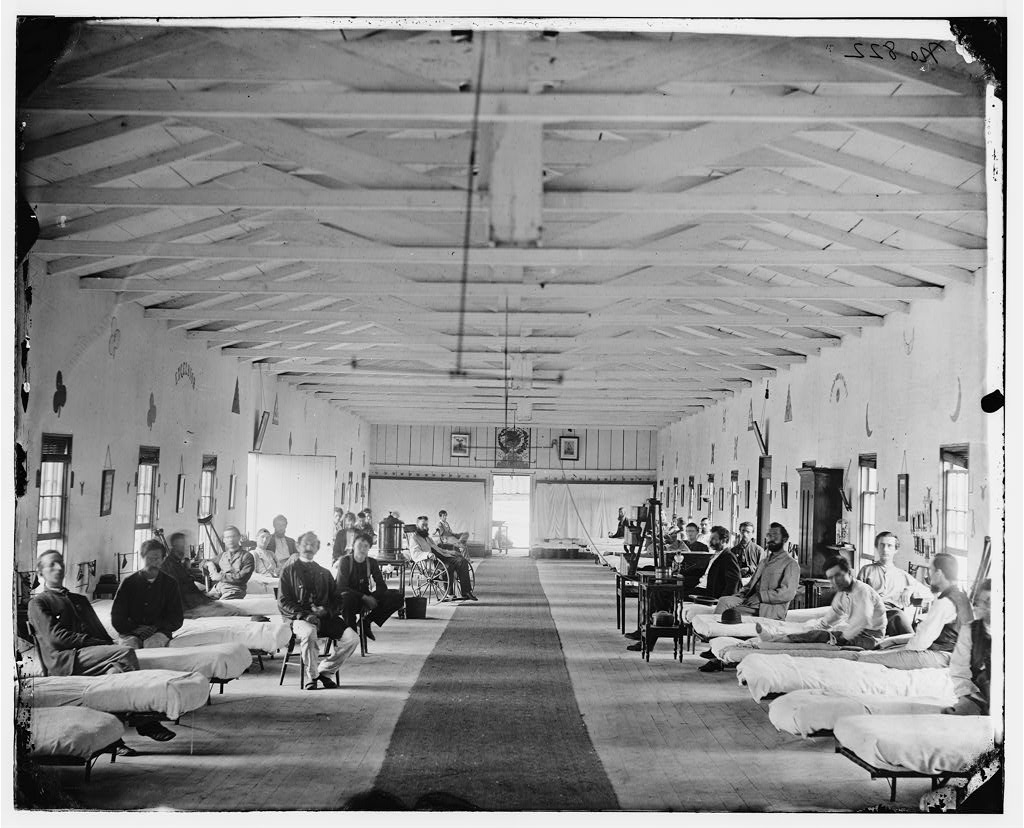
Washington, D.C. Patients in Ward K of Armory Square Hospital
Clara Barton was almost killed during the Antietam Campaign in September, 1862. While she is attending to an injured soldier a bullet passes through a sleeve of her dress. The bullet misses Clara, but strikes and kills the injured soldier. Clara also dug a bullet out the cheek of another soldier using only her pocketknife. A few days after Antietam, Barton becomes ill with typhoid fever.
Clara Barton was working in field hospitals of General Benjamin Butler’s Army of the James in June, 1864. Also in 1864, Barton was part of a petition along with other notables such as Horace Greeley, P. T. Barnum, William Cullen Bryant, and Henry Wadsworth Longfellow, for the establishment of veteran’s homes. By 1933, fifteen such homes were built.
In February 1865, President Abraham Lincoln appointed Clara Barton to attend to correspondence to help reunite missing soldiers with their families. That July, she was at the infamous Andersonville prison in Georgia to manage the identification of unmarked graves. From hospital and burial records, Clara was able to create a list of missing prisoners.
In 1877, Clara Barton organized the American National Committee and three years later it became the American Red Cross. Clara served as the first president of the American Red Cross and she published a book in 1882, titled: History of the Red Cross.
Clara Barton retired from the Red Cross to her home at Glen Echo outside of Washington, D.C. in 1904. “The Angel of the Battlefield died on April 12, 1912.
“If I were to speak of war, it would not be to show you the glories of conquering armies but the mischief and misery they strew in their tracks; and how, while they marched on with tread of iron and plumes proudly tossing in the breeze, some one must follow closely in their steps, crouching to the earth, toiling in the rain and darkness, shelterless themselves, with no thought of pride or glory, fame or praise, or reward; hearts breaking with pity, faces bathed in tears and hands in blood. This is the side which history never shows.”
— Clara Barton
Clara Barton: The Beginnings of the American Red Cross
