Quotes Of Union General William Tecumseh Sherman
War Is Hell
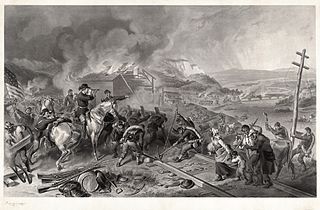
Sherman’s march To The Sea
-
“Oh, it is all folly, madness, a crime against civilization.”
…Union Colonel William Tecumseh Sherman upon hearing of South Carolina’s secession from the Union. Sherman had lived in the South for nearly 12 years, and he had a true fondness for the South. Sherman would play a major part in winning the Civil War for the Union.
-
“I see every chance of a long, confused and disorganizing civil war, and I feel no desire to take a hand therein.”
…Sherman wrote these words to his wife Ellen, in January 1861.
-
“You people of the South don’t know what you are doing. This country will be drenched in blood, and God only knows how it will end.
“The North can make a steam engine, locomotive or railway car; hardly a yard of cloth or a pair of shoes can you make. You are rushing into war with one of the most powerful, ingeniously mechanical and determined people on earth-right at your doors. You are bound to fail. Only in spirit and determination are you prepared for war. In all else you are totally unprepared, with a bad cause to start with.
“You people speak so lightly of war; you don’t know what you’re talking about. War is a terrible thing!
“You mistake, too, the people of the North. They are a peaceable people but an earnest people, and they will fight, too. They are not going to let this country be destroyed without a mighty effort to save it…Besides, where are your men and appliances of war to contend against them?
“At first you will make headway, but as your limited resources begin to fail, shut out from the markets of Europe as you will be, your cause will begin to wane. If your people will but stop and think, they must see that in the end you will surely fail.”
…The prophetic words of William Tecumseh Sherman on December 24, 1860, after he learned of South Carolina’s secession. Sherman was superintendent of the Louisiana State Seminary and Military Academy at the time.
-
“You might as well attempt to put out the flames of a burning house with a squirt-gun. I think this is to be a long war-very long-much longer than any politician thinks.”
…William Tecumseh Sherman, assessing the war in 1861.
-
“I begin to regard the death and mangling of a couple thousand men as a small affair, a kind of morning dash-and it may be well that we become so hardened.”
…General Sherman, from a letter to his wife written in July, 1864.
-
“Three years ago by a little reflection and patience they could have had a hundred years of peace and prosperity…Last year they could have saved their slaves, but now it is too late…Next year their lands will be taken…and in another year they may beg in vain for their lives.”
…General Sherman in January, 1864 regarding the situation of the Rebels. Lee surrendered to Grant on April 9, 1865 and the Civil War was over. Happily, Sherman is wrong here with his time estimate of the continuation of the war.
-
“If you don’t have my army supplied, and keep it supplied, we’ll eat your mules up, sir.”
…General Sherman’s warning to an army quartermaster before the departure of Sherman’s army from Chattanooga and heading toward Atlanta.
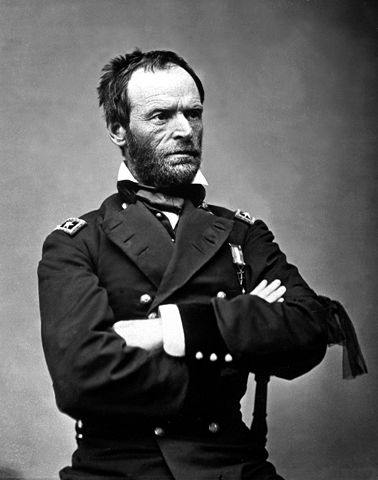
William Tecumseh Sherman
-
“Until we can repopulate Georgia, it is useless for us to occupy it; but the utter destruction of its roads, houses and people will cripple their military resources. I can make this march, and make Georgia howl.”
…General Sherman, from a telegram sent to General Ulysses S. Grant at Atlanta, Georgia. September 9, 1864.
-
“The whole army is burning with an insatiable desire to wreak violence upon South Carolina. I almost tremble for her fate.”
…General William T. Sherman, as he prepared to march his army into South Carolina. This was following the March to the Sea.
-
“We have devoured the land and our animals eat up the wheat and cornfields close. All the people retire before us and desolation is behind. To realize what war is one should follow our tracks.”
…General William Tecumseh Sherman.
-
“That devil Forrest… must be hunted down and killed if it costs ten thousand lives and bankrupts the Federal treasury.”
…Sherman referring to Confederate General Nathan Bedford Forrest.
-
“After all, I think Forrest was the most remarkable man our Civil War produced on either side.”
…After the Civil War, Sherman made these comments about Confederate General Nathan Bedford Forrest.
-
“Wars are not all evil, they are part of the grand machinery by which this world is governed.”
…General William Tecumseh Sherman.
-
“War is at best barbarism…Its glory is all moonshine. It is only those who have neither fired a shot, nor heard the shrieks and groans of the wounded who cry aloud for blood, more vengeance, more desolation. War is hell.”
…William Tecumseh Sherman. These words are from his June 19, 1879 address to the Michigan Military Academy.
 My book 501 Civil War Quotes and Notes features quotes made before, during, and after the Civil War. Each quote has an informative note to explain the circumstances and background of the quote. Learn Civil War history from the spoken words and writings of the military commanders, political leaders, the Billy Yanks and Johnny Rebs who fought in the battles, the abolitionists who strove for the freedom of the slaves, the descriptions of battles, and the citizens who suffered at home. Their voices tell us the who, what, where, when, and why of the Civil War. Available as a Kindle device e-book or as a paperback. Get 501 Civil War Quotes and Notes now!