Gettysburg – The Last Invasion
by Allen C. Guelzo
With his book: Gettysburg – The Last Invasion, esteemed Civil War historian Allen C. Guelzo has written a complete explanation of what happened at the Battle of Gettysburg in a thorough, thought-provoking, and entertaining way. By including many quotes, he brings personality and life to those who fought at Gettysburg and he richly tells an accurate and factual story of the battle with his own words.
This is a book that deserves a place on the top shelf of your Civil War library. If you read this book at home while sitting in your most comfortable easy chair, then you will feel like you’ve been at Gettysburg during the battle, it will be made real for you. If you tour Gettysburg and refer to passages in Guelzo’s book as you look upon and walk the various park trails, hills, ridges, roads, fields, and landmarks where the fighting took place, then you will know who did what, where, when, and how, during the battle. This is a study of the Battle of Gettysburg told in an enjoyable, engaging, and informative way.
Allen C. Guelzo is highly qualified to write about the Battle of Gettysburg. He is the Henry R. Luce Professor of the Civil War Era and Director of Civil War Era Studies at Gettysburg College. Guelzo has done all the necessary footwork and bookwork to pen a comprehensive book about Gettysburg. His scholarly achievements are immense, and as Gettysburg College is adjacent to the Gettysburg National Military Park, he has done the fieldwork. This book is expertly researched, but easy reading and hard to put down.
Guelzo is the right person, with the right credentials, with the right knowledge, at the best place, and at the right time, to write such a fine book about the Battle of Gettysburg. Guelzo will tell you what happened at Gettysburg… and perhaps with some controversy too, he will explain how the battle might have turned out very differently if some particular events had not happened as they did. The timing is perfect with the publication of this book during the Sesquicentennial Anniversary year of the Battle of Gettysburg, but Gettysburg – The Last Invasion will be a must-read for all-time for anyone who wants to learn about Gettysburg.
I believe this book is an instant Civil War classic, and awards and praise will come for Allen C. Guelzo and his Gettysburg – The Last Invasion.
About the Author: Allen C. Guelzo
- Guelzo is the Henry R. Luce Professor of the Civil War Era and Director of Civil War Era Studies at Gettysburg College.
- He is the author of Lincoln’s Emancipation Proclamation: The End of Slavery in America and Abraham Lincoln: Redeemer President, both winners of the Lincoln Prize.
- Guelzo’s essays, reviews, and articles have appeared in publications ranging from The American Historical Review and The Wilson Quarterly to newspapers such as The Philadelphia Inquirer and The Wall Street Journal.
Allen Guelzo on July 3, 1863
Accolades For Gettysburg – The Last Invasion
“An extraordinary work of thorough scholarship combined with a lifetime of judgement about historic events. If you need a clear, direct introduction to the greatest battle on American soil this is a wonderful book. If you have read fifty books on Gettysburg but are looking for new insights and facts that illuminate things you had never considered this is the book. Everyone interested in the decisive moment in Freedom’s struggle should read Guelzo’s simply extraordinary book.“
Newt Gingrich, former Speaker of the House and coauthor of Gettysburg: A Novel of the Civil War.
“Despite all that has been written about the Battle of Gettysburg, Allen C. Guelzo provides new information and insights in this stirring account. Unafraid to challenge conventional wisdom, he praises General O. O. Howard, maintains that General George G. Meade did indeed contemplate retreat on July 2 but was persuaded otherwise by subordinates, and criticizes Meade for missed opportunities in the pursuit after the battle. Readers will find much to think about in this book.“
James M. McPherson, Pulitzer Prize-winning author of Battle Cry of Freedom.
Book Details
- ISBN-13: 9780307594082
- Publisher: Knopf Doubleday Publishing Group
- Publication date: 5/14/2013
- Pages: 656
- Book dimensions: 6.00″ wide x 9.30″ high x 1.50″ deep
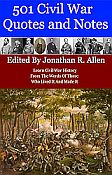 My book 501 Civil War Quotes and Notes features quotes made before, during, and after the Civil War. Each quote has an informative note to explain the circumstances and background of the quote. Learn Civil War history from the spoken words and writings of the military commanders, political leaders, the Billy Yanks and Johnny Rebs who fought in the battles, the abolitionists who strove for the freedom of the slaves, the descriptions of battles, and the citizens who suffered at home. Their voices tell us the who, what, where, when, and why of the Civil War. Available as a Kindle device e-book or as a paperback. Get 501 Civil War Quotes and Notes now!