The “Swamp Angel” – A Union 200-Pounder Parrott Gun.
August 22-23, 1863
The “Swamp Angel” was a Union 200-pounder Parrott Gun used on August 22-23, 1863, at Morris Island in Charleston Harbor, South Carolina to shell nearby Charleston.
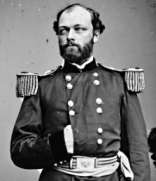
Quincy A. Gillmore
By the summer 1863, the Confederate held Fort Sumter had been bombarded by Federal artillery for two years, but the fort still stood and guarded Charleston. At the entrance to Charleston Harbor is Morris Island and Union General Quincy A. Gillmore and his troops were stationed there. Gillmore wanted to construct an artillery battery on Morris Island so he could directly bombard Charleston and force the city to surrender. Gillmore’s plan would bypass troublesome Fort Sumter and other forts in the Charleston Harbor. A big gun with the range to bombard Charleston would allow Gillmore to force the rebel stronghold of Charleston to surrender. General Gillmore needed the Swamp Angel.
The Swamp Angel was huge. It was cast of iron at the West Point Foundry in New York and it weighed 16,700 pounds. The Swamp Angel’s barrel bore was 8-inches and it had an 11-foot bore depth. Even the construction of the battery and parapet needed for the Swamp Angel was impressive. Merely getting this giant gun into place on the swampy, mushy, ground of Morris Island (with mud sometimes twenty-feet deep) in Charleston Harbor was a challenging engineering job. Construction of the battery and parapet began on August 2, and it included:
- 13,000 sandbags weighing greater than 800 tons total
- 123 pine timbers, 45-55 feet in length and 15-18 inches in diameter
- 5,000 feet of 1-inch thick board
- 9,500 feet of 3-inch thick planking
- The spikes, nails, and iron required to hold it all together weighed 1,200 pounds
- 75 fathoms (450 feet) of rope, 3 inches thick
The Swamp Angel used a 17-pound powder charge to fire a 200-pound projectile 7,900 yards into the heart of Charleston. To add to the threat of the Swamp Angel, the projectiles could be filled with an incendiary fluid called “Greek Fire” that would set Charleston ablaze. On August 17 the Swamp Angel arrived at Morris Island. An awesome weapon of war was about to go to work.
A Huge Monster Cannon
Gillmore sent a message on August 21, to General P. G. T. Beauregard demanding the evacuation of Confederate posts on Morris Island and Fort Sumter, or else shelling of Charleston would start. The Yankees had sighted the Swamp Angel in on the steeple of St. Michael’s Church. Beauregard gave no reply to Gillmore’s demands.
At 1:30 A.M. on August 22, the Swamp Angel belched and roared its first shot at Charleston. Bells, whistles, and alarms from Charleston could soon be heard on Morris Island. Before daylight arrived, fifteen more shots rained down on Charleston from the Swamp Angel. Twelve of these shots filled with Greek Fire.
Charleston was receiving the wrath of the Union in the form of horrible huge shells filled with fire, shot from a huge monster cannon 7,900 yards away. On August 23, the Swamp Angel belched out more shells into Charleston. It looked like the Confederacy would have to surrender Charleston as the Swamp Angel rained its hellish fiery shells on the city.
When the Swamp Angel fired its thirty-sixth shell on August 23, it did something cast-iron Parrott guns were known for, despite their distinctive wrought iron reinforcing bands positioned around their breeches. On its thirty-sixth firing that day the Swamp Angel’s breech blew out and the gun’s barrel flew on top of the sandbag parapet. The great Swamp Angel was dead.
Although it had suffered some damage and a few fires were set by the Swamp Angel, Charleston was now safe. No further huge guns like the Swamp Angel were placed on the Union’s Morris Island battery.
The Swamp Angel
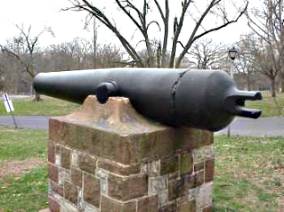
The Swamp Angel
If you visit Trenton today, you will find the Swamp Angel at Cadwalader Park. Even if it could still fire and despite all its monstrous might, the Civil War Swamp Angel’s Greek Fire projectiles could not reach Charleston, South Carolina from Trenton, New Jersey. The people of Charleston may rest easy. The Swamp Angel is no longer a threat to them.
The Swamp Angel picture is courtesy of: CivilWarAlbum.com