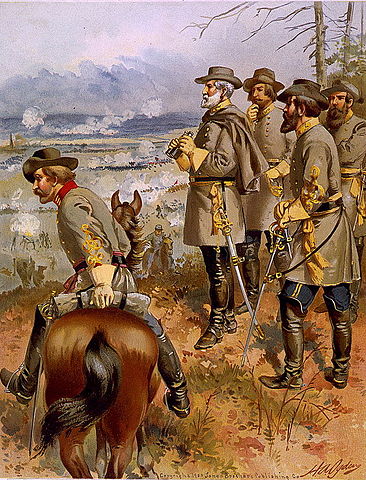
Robert E. Lee at Fredericksburg
Robert Edward Lee was born on January 19, 1807, at Stratford, Virginia. He was the son of Henry “Light-Horse Harry” Lee, a Revolutionary War hero. He graduated second in his class at the United States Military Academy at West Point in 1829. Lee married Mary Anna Randolph Custis on July 5, 1831. Mary was a descendant of John Parke Custis, who was George Washington’s adopted son. Robert E. Lee then served for seventeen years in the Corps of Engineers where his work involved overseeing and inspecting the building of coastal defenses. During the Mexican-American War Lee was a member of General Winfield Scott’s staff. He became a colonel and earned three brevets for gallantry.
Robert E. Lee was the superintendent of West Point from 1852 to 1855. Ironically, while he was West Point’s superintendent he would further the military education of many young men who would later fight with and against him in the Civil War. Lee left West Point in 1855 to take a position commanding the 2nd Cavalry. In October 1859, Robert E. Lee was sent to Harpers Ferry, Virginia to end abolitionist John Brown’s raid on the Harpers Ferry Arsenal and Armory.
With the start of the Civil War in April 1861, President Abraham Lincoln offered Robert E. Lee command of the Union army. Lee declined Lincoln’s offer and instead resigned from the United States Army to side with the Confederate States of America when his home state of Virginia seceded on April 17. Robert E. Lee became the commander of the Army of Northern Virginia in June 1862. Lee’s battle successes were the Peninsula Campaign, Second Bull Run (Second Manassas), Fredericksburg, and Chancellorsville. Antietam was a tactical stalemate for Lee and George B. McClellan, but it was a strategic victory for the Army of the Potomac. Robert E. Lee’s greatest battle loss was the Battle of Gettysburg, but his ultimate loss was when he surrendered his Army of Northern Virginia to General Ulysses S. Grant at Appomattox Court House, Virginia on April 9, 1865.
After the Civil War Robert E. Lee became the president of Washington College in Lexington, Virginia. He died in Lexington on October 12, 1870. Robert E. Lee is revered today as one of the greatest military commanders ever.
Robert E. Lee Quotes Before The Civil War
***
“I can anticipate no greater calamity for the country than a dissolution of the Union. It would be an accumulation of all the evils we complain of, and I am willing to sacrifice anything but honor for its preservation.”
… From a letter Robert E. Lee wrote on January 23, 1861.
***
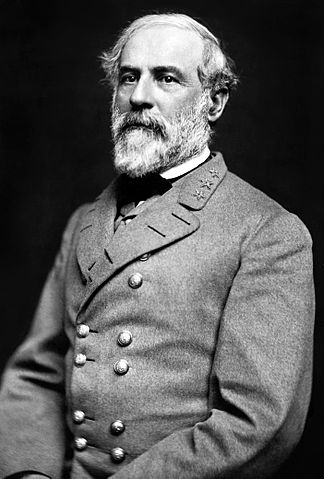
Robert E. Lee
“In this enlightened age, there are few I believe, but what will acknowledge, that slavery as an institution, is a moral & political evil in any Country. It is useless to expatiate on its disadvantages. I think it however a greater evil to the white man than to the black race, & while my feelings are strongly enlisted in behalf of the latter, my sympathies are more strong for the former. The blacks are immeasurably better off here than in Africa, morally, socially & physically. The painful discipline they are undergoing, is necessary for their instruction as a race, & I hope will prepare & lead them to better things. How long their subjugation may be necessary is known & ordered by a wise Merciful Providence. Their emancipation will sooner result from the mild & melting influence of Christianity, than the storms & tempests of fiery Controversy. This influence though slow, is sure. The doctrines & miracles of our Saviour have required nearly two thousand years, to Convert but a small part of the human race, & even among Christian nations, what gross errors still exist! While we see the Course of the final abolition of human Slavery is onward, & we give it the aid of our prayers & all justifiable means in our power, we must leave the progress as well as the result in his hands who sees the end; who Chooses to work by slow influences; & with whom two thousand years are but as a Single day. Although the Abolitionist must know this, & must See that he has neither the right or power of operating except by moral means & suasion, & if he means well to the slave, he must not Create angry feelings in the Master; that although he may not approve the mode which it pleases Providence to accomplish its purposes, the result will nevertheless be the same; that the reasons he gives for interference in what he has no Concern, holds good for every kind of interference with our neighbors when we disapprove their Conduct; Still I fear he will persevere in his evil Course. Is it not strange that the descendants of those pilgrim fathers who Crossed the Atlantic to preserve their own freedom of opinion, have always proved themselves intolerant of the Spiritual liberty of others?”
… Robert E. Lee writing to his wife Mary on December 27, 1856. Lee explains in these words that he believes it is up to God to decide when slavery should end. The reader may learn a lot about Robert E. Lee from his own words, and the reader might draw an opinion about the character of the man.
***
“I am one of the dull creatures that cannot see the good of secession.”
… A thought of Robert E. Lee in 1861.
***
“A soldier has a hard life and but little consideration.”
… Robert E. Lee and Lewis Armistead were both serving at Fort Riley in Kansas before the Civil War. Tragedy struck when Armistead’s wife died during an epidemic at the fort while he was away leading his company. Armistead returned to the fort, buried his wife, and the next day took his children with him when he returned to his company duty in the field.
***
“A Union that can only be maintained by swords and bayonets has no charm for me. If the Union is dissolved and government disrupted, I shall return to my native state and share the miseries of my people, and save in defense will draw my sword on none.”
… Robert E. Lee, in a letter written on January 23, 1861, from Fort Mason, Texas.
***
“Where is my little boy?”
… When he returned home to Arlington after a two-year absence from his family while he fought in the Mexican War, Robert E. Lee was anxious to see his young son Robert. A friend of Mary Lee’s had stopped by to visit and her young son was with her. Young Robert and the other boy began playing together away from the adults. Robert E. Lee arrived home from Mexico while the boys were playing together. Lee saw the two young boys and making his way to them he said, “Where is my little boy?” He bent over and lifted young Robert’s play companion up in the air and gave him a kiss. After two years of being away, Robert E. Lee did not recognize young Robert, who had certainly grown and changed since the last time his father saw him.
***
Robert E. Lee Quotes During The Civil War
***
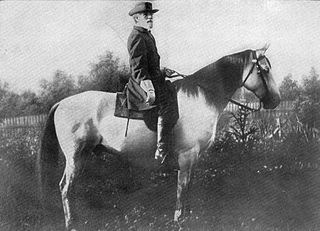
General Robert E. Lee and Traveler
“Never mind, General, all this has been my fault; it is I that have lost this fight, and you must help me out of it in the best way you can.”
… General Robert E. Lee to General Wilcox on July 3, 1863, at the Battle of Gettysburg after the failure of Pickett’s Charge. Observer Colonel A. J. Lyon Fremantle of the British Army had this Lee quote as an entry in his diary.
***
“This has been a sad day for us, Colonel, a sad day; but we can’t always expect to gain victories.”
… General Robert E. Lee said this to Colonel A. J. Lyon Fremantle after Pickett’s Charge failed at the Battle of Gettysburg. July 3, 1863.
***
“I have been up to see the Congress and they do not seem to be able to do anything except to eat peanuts and chew tobacco, while my army is starving.”
… General Robert E. Lee venting his frustration with the Confederate Congress. In March 1865, Lee’s Army of Northern Virginia badly needed supplies, but was not getting them. The end was near.
***
“You see what a poor sinner I am, and how unworthy to possess what was given me; for that reason it has been taken away.”
… Robert E. Lee from a December 1861 letter he wrote to his daughter after their family home of Arlington had been taken by the Yankees. Lee was away on duty in South Carolina at the time.
***
“I can only say that I am nothing but a poor sinner, trusting in Christ alone for salvation.”
… General Robert E. Lee declaringing his faith in Jesus Christ.
***
“I am glad to see one real American here.”
… Union Lieutenant Colonel Ely S. Parker was a Seneca Indian and an adjutant on General Ulysses Grant’s staff. Parker was at Appomattox Court House on April 9, 1865, when Robert E. Lee surrendered to Grant. Lee said this to Parker, and Parker replied to Lee, “We are all Americans.”
***
“What a cruel thing is war; to separate and destroy families and friends, and mar the purest joys and happiness God has granted us in this world; to fill our hearts with hatred instead of love for our neighbours, and to devastate the fair face of this beautiful world! I pray that, on this day when only peace and good-will are preached to mankind, better thoughts may fill the hearts of our enemies and turn them to peace. … My heart bleeds at the death of every one of our gallant men.”
… Robert E. Lee writing to his wife Mary in late December 1862. The Battle of Fredericksburg was fought December 11-15, 1862. Fredericksburg was a Confederate victory with great loss of men for the Yankees.
***
“Negroes belonging to our citizens are not considered subjects of exchange and were not included in my proposition.”
… Robert E. Lee would not include African-American Union prisoners in any prisoner exchanges. Lee’s logic was that the African-American Union soldiers were probably runaways who belonged to Southern owners. They were not to be exchanged and instead should be returned to their masters.
***
“You will, however, learn before this reaches you that our success at Gettysburg was not so great as reported–in fact, that we failed to drive the enemy from his position, and that our army withdrew to the Potomac. Had the river not unexpectedly risen, all would have been well with us; but God, in His all-wise providence, willed otherwise, and our communications have been interrupted and almost cut off.”
… Robert E. Lee writing home after losing to George G. Meade and the Army of the Potomac at the Battle of Gettysburg.
***
“Our people are opposed to work. Our troops, officers, community, and press all ridicule and resist it. It is the very means by which McClellan has and is advancing. Why should we leave to him the whole advantage of labor. Combined with valour, fortitude & boldness, of which we have our fair proportion, it should lead us to success. What carried the Roman soldiers into all Countries but that happy combination? There is nothing so military as labor, and nothing so important to an army as to save the lives of its soldiers.”
… On June 5, 1862, General Robert E. Lee wrote this to Confederate President Jefferson Davis.
***
“This is a sad business, Colonel. …It has happened as I told them in Richmond it would happen. The line has been stretched until it is broken.”
… Robert E. Lee was riding toward Petersburg, Virginia on April 2, 1865. These are Lee’s words to an aide as they rode along together. The time of the Army of Northern Virginia and the Confederate States of America was now short.
***
“My interference in battle would do more harm than good. I have, then, to rely on my brigade and division commanders. I think and work with all my power to bring the troops to the right place at the right time; then I have done my duty. As soon as I order them into battle, I leave my army in the hands of God.”
… Robert E. Lee summarizes his battle duty.
***
Headquarters Army No Va
August 13th 1863General Orders No 83,
The President of the Confederate States has, in the name of the people, appointed the 21st day of August as a day of humiliation, fasting and prayer. A strict observance of the day is enjoined upon the officers and soldiers of this Army. All Military duties, except such as are absolutely necessary, will be suspended.
The Commanding Officers of Brigades and Regiments are requested to cause divine services suitable to the occasion to be performed in their respective commands.
Soldiers! We have sinned against Almighty God. We have forgotten His signal mercies and have cultivated a vengeful, haughty and boastful spirit. We have not remembered that the defenders of a just cause should be pure in His eyes; that our lives are in His hand and we have relied too much on our own arms for the achievement of our independence.
God is our only refuge and our strength. Let us humble ourselves before Him. Let us confess our many sins and beseech Him to give us a higher Courage, a purer patriotism and more determined will. That He will convert the hearts of our enemies; that He will hasten the time when war with its sorrows and sufferings shall cease, and that He will give us a name and peace among the Nations of the earth.
R E Lee
Genl
… General Robert E. Lee issued General Orders No. 83 to his men after the Army of Northern Virginia’s loss at the Battle of Gettysburg.
***
“I suppose there is nothing for me to do but go and see General Grant. And I would rather die a thousand deaths.”
… General Robert E. Lee before his surrender to General Ulysses S. Grant at Appomattox Court House on April 9, 1865. Many, many, many thousands of young Yankees and Rebels had perished in the Civil War. Lee himself, would die of natural causes in 1870 in a united country without the peculiar institution of slavery.
***
 Does reading about Civil War history from long and dry academic-like books bog you down and cause you to lose interest? Would you like to read interesting stories based on facts of the Civil War, stories that inform you and move along with the war’s history? Does having to read from cover to cover tire you and cause you to drag through a history book? Would you prefer the freedom to skip around in a book and learn story-by-story about the Civil War? If you answered “yes” to any of these questions, then the factual stories in 125 Civil War Stories and Facts will help you learn Civil War history. The stories are informative and entertaining and it’s a fun way to learn about the Civil War. Do books like Civil War Trivia and Fact Book by Webb Garrison or The Civil War: Strange & Fascinating Facts by Burke Davis interest you? Then you will find 125 Civil War Stories and Facts follows in their tradition of providing the reader with rich and interesting information about the Civil War. Available as a Kindle device e-book or as a paperback. Get 125 Civil War Stories and Facts now!
Robert E. Lee Quotes After The Civil War
***
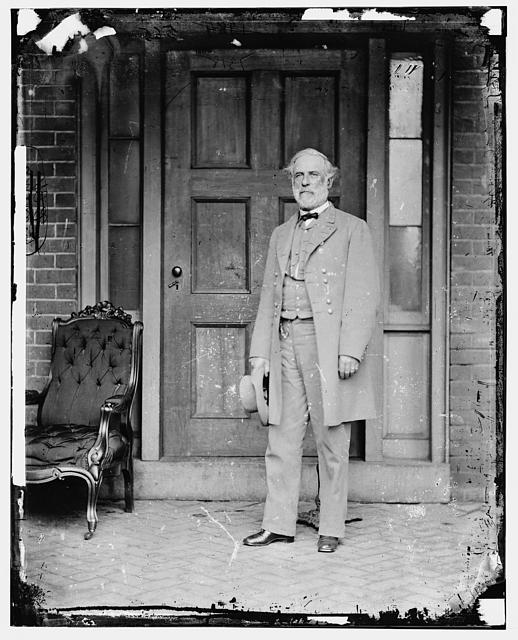
Robert E. Lee
“I, Robert E. Lee of Lexington, Virginia do solemn, in the presence of Almighty God, that I will henceforth faithfully support, protect and defend the Constitution of the United States, the Union of the States thereafter, and that I will, in like manner, abide by and faithful support all laws and proclamations which have been made during the existing rebellion with reference to the emancipation of slaves, so help me God.”
… Robert E. Lee’s amnesty oath, October 2, 1865.
***
“We failed, but in the good providence of God apparent failure often proves a blessing.”
… Robert E. Lee regarding the South’s secession from the United States of America. From a letter of March 22, 1869.
***
“I am now considered such a monster, that I hesitate to darken with my shadow, the doors of those I love, lest I should bring upon them misfortune.”
… Robert E. Lee was in Washington D.C. ten months after the Civil War ended. The former Confederate General was not a welcome or popular man in this city and he knew it. He chose not to visit his friends in Washington, D.C. out of concern for the trouble it may cause them.
***
“…I believe it to be the duty of everyone to unite in the restoration of the country, and the re-establishment of peace and harmony…. It appears to me that the allayment of passion, the dissipation of prejudice, and the restoration of reason, will alone enable the people of the country to acquire a true knowledge and form a correct judgment of the events the last four years. It will, I think, be admitted that Mr. Davis has done nothing more than all the citizens of the Southern States, and should not be held accountable for acts performed by them in the exercise of what had been considered by them unquestionable right.”
… Robert E. Lee, September 1865.
***
“The questions which for years were in dispute between the State and General Government, and which unhappily were not decided by the dictates of reason, but referred to the decision of war, having been decided against us, it is the part of wisdom to acquiesce in the result, and of candor to recognize the fact.”
… Robert E. Lee, from a letter to former Virginia governor John Letcher on August 28, 1865.
***
“The only question on which we did not agree has been settled, and the Lord has decided against me.”
… Robert E. Lee after the Civil War was over.
***
“Sir, if you ever presume again to speak disrespectfully of General Grant in my presence, either you or I will sever his connection with this university.”
… Robert E. Lee’s words to a faculty member at Washington College in Lexington, Virginia after the faculty member had spoken insultingly of Ulysses S. Grant. Lee was the president of Washington College after the Civil War. Washington College would later honer Robert E. Lee by changing its name to Washington and Lee University.
***
“I did only what my duty demanded; I could have taken no other course without dishonor & if all was to be done over again, I should act precisely in the same manner.”
… Robert E. Lee after the Civil War.
***
“I prefer the Bible to any other book. There is enough in that, to satisfy the most ardent thirst for knowledge; to open the way to true wisdom; and to teach the only road to salvation and eternal happiness.”
… Robert E. Lee to his cousin Markie, December 1865.
***
“I have fought against the people of the North because I believed they were seeking to wrest from the South its dearest rights. But I have never cherished toward them bitter or vindictive feelings, and I have never seen the day when I did not pray for them.”
… After the Civil War, Robert E. Lee practiced and wanted reconciliation between the North and the South.
***
“I like whiskey. I always did, and that is the reason I never use it.”
… Robert E. Lee was an abstainer of Oh! Be Joyful.
***
“Do your duty in all things like the old Puritan. You cannot do more; you should never wish to do less. Never let your mother or me wear one gray hair for any lack of duty on your part.”
… This is an excerpt from a letter Robert E. Lee wrote to his son, George Washington Custis Lee.
***
“I cannot trust a man to control others who cannot control himself.”
… Robert E. Lee.
***
 My book 501 Civil War Quotes and Notes features quotes made before, during, and after the Civil War. Each quote has an informative note to explain the circumstances and background of the quote. Learn Civil War history from the spoken words and writings of the military commanders, political leaders, the Billy Yanks and Johnny Rebs who fought in the battles, the abolitionists who strove for the freedom of the slaves, the descriptions of battles, and the citizens who suffered at home. Their voices tell us the who, what, where, when, and why of the Civil War. Available as a Kindle device e-book or as a paperback. Get 501 Civil War Quotes and Notes now!