Washington D.C. In The Civil War
Washington D.C. – the Capital of the United States
Washington D.C. went through many changes during the Civil War.
- Washington D.C. underwent a dramatic transformation during the Civil War, evolving from a relatively small, underdeveloped city into a bustling, heavily fortified Union capital.
- Washington D.C. served as the official capital of the Union throughout the entire Civil War.
- Washington D.C. was strategically and precariously located, sandwiched between Confederate Virginia and the border slave state of Maryland. It was highly vulnerable to attack by Rebel forces.
- The population of Washington D.C. exploded during the Civil War. It increased from approximately 75,080 at the start of the war to an estimated 200,000 at its peak. There was an influx of soldiers, government workers, refugees, and formerly enslaved people who came to Washington D.C.
- At the Civil War’s outset, Washington D.C. was largely undefended and vulnerable. There was only one old fort (Fort Washington) that was located 12 miles south of the city.
- Following the First Battle of Bull Run/First Manassas, a massive fortification effort began in Washington D.C. resulting in a ring of defenses around the city.
- By 1865, Washington D.C. was one of the most heavily fortified cities in the world. It had 68 enclosed forts, 93 detached batteries, 20 miles of rifle pits, and 32 miles of military roads.
- The formidable Civil War defenses of Washington D.C. largely deterred direct Confederate assaults on the capital, though feints and indirect threats were common.
- President Abraham Lincoln famously observed the fighting at Fort Stevens on July 12, 1864,when Confederate Lt. Gen. Jubal Early’s forces assaulted the fort. This made him the only United States president to come under direct enemy fire while in office. At Fort Stevens, Lincoln was fired at by sharpshooters which prompted a Union officer to shout, “Get down, you damn fool!“.
- The rapid population growth of Washington D.C. during the Civil War strained the city’s infrastructure and resources. The city was troubled with poor sanitation, muddy streets, and outbreaks of diseases like smallpox.
- In Washington D.C. during the Civil War, many buildings, including the Patent Office and public halls, were converted into hospitals to care for the thousands of wounded Union soldiers arriving from the front lines.
- Slavery was abolished in Washington D.C. in April 1862, it the first emancipated city and a magnet for formerly enslaved people.
- “Freedom villages” and “contraband camps” sprang up around Washington D.C. to accommodate the thousands of formerly enslaved people seeking refuge and freedom.
- During the Civil War in Washington D.C. many formerly enslaved people found employment and contributed to the war effort. They helped to construct the city’s defenses.
- Beyond the military front, Washington D.C. was a major political battleground. There were intense debates over emancipation and the future of the nation.
- In Washington D.C., the Civil War spurred advancements in medicine and technology. Thaddeus Lowe used balloons for reconnaissance with support from the Smithsonian Institution.
- During the Civil War in Washington D.C. President Abraham Lincoln was a constant presence. He often visited hospitals, and oversaw military operations as he grappled with the severe challenges of the Civil War.
- The infamous assassination of President Lincoln by cowardly actor John Wilkes Booth occurred at Ford’s Theatre in Washington, D.C. in April 1865.
- The Civil War officially ended with the Grand Review of the Armies in May 1865 when a massive parade of Union troops proceded through the streets of Washington, D.C.
- The Civil War fundamentally transformed Washington D.C., laying the groundwork for its development into a major metropolitan center. There was enormous post-Civil War growth.
- During and after the Civil War, Washington, D.C.’s character shifted from its Southern origins to a more Northern influence, reflecting the influx of Union supporters and freed-people.
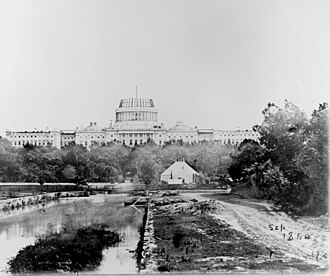
Capitol Under Construction in Washington D.C. 1860.
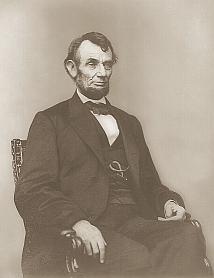
President Abraham Lincoln
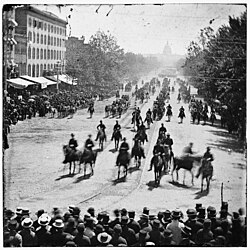
Grand Review in Washington D.C.

(Visited 135 times, 4 visits today)